Curly mallow
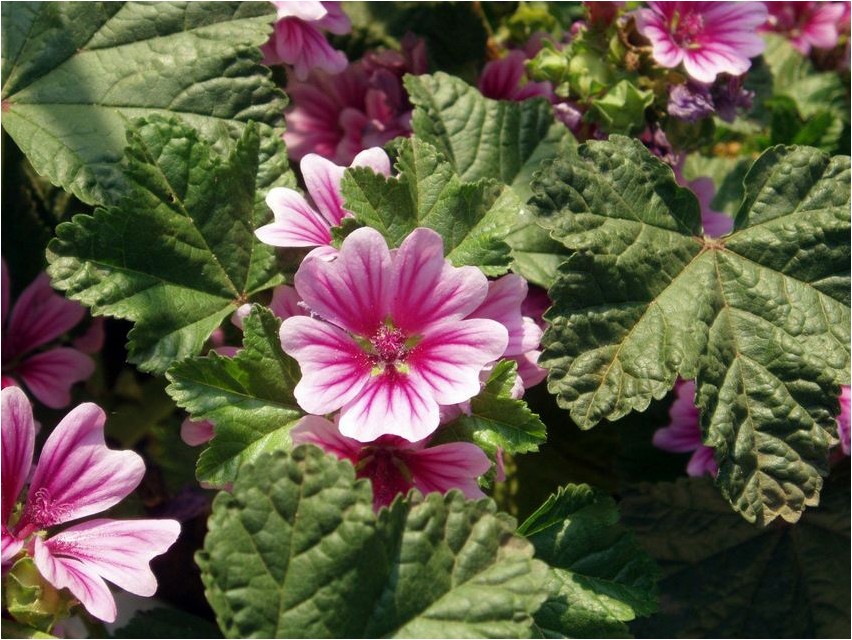
Curly mallow is one of the plants of the family called malvaceae; in Latin the name of this plant will be as follows: Malva crispa (L.).
As for the name of the curly mallow family itself, in Latin it will be like this: Malvaceae Juss.
Description of curly mallow
Curly mallow is an annual herbaceous plant, the height of which will fluctuate between forty and two hundred centimeters. The stems of this plant are straight, they can be either bare or endowed with scattered star-shaped hairs at the top. The leaves of curly mallow are long-petioled, especially the lower leaves. Such leaves will be five to seven lobed, they are jagged along the edges, and will also be folded and wavy. The flowers of this plant are quite numerous; they can be either almost sessile or on short stalks. Curly mallow flowers are collected in the axils in glomeruli, with the corolla approximately one and a half to two times larger than the calyx, the petals will be broadly ovate. The corolla of this plant is colored either pink, white, or pale purple. The fruits of this plant consist of ten to eleven pale and bare fruitlets; the seeds are very small and are colored brown.
This plant blooms from June to October. Under natural conditions, curly mallow is found in Western Siberia, the Daursky region of Eastern Siberia, as well as all regions of the European part of Russia, with the exception of only the north of the Dvina-Pechora and Karelo-Murmansk regions. For growth, this plant prefers gardens, vegetable gardens and garbage areas. It is noteworthy that curly mallow is not only an ornamental plant, but also a very valuable honey plant.
Description of the medicinal properties of curly mallow
Curly mallow is endowed with very valuable healing properties, and it is recommended to use the roots and herbs of this plant for medicinal purposes. The term grass includes leaves, stems and flowers. The presence of such valuable healing properties should be explained by the content of mucilage in all parts of this plant, while carbohydrates are present in the roots, carotene is found in the aboveground part of the plant, and carbohydrates are found in the stems.
A decoction prepared from the aerial part of curly mallow is recommended for use for colds, burns, skin and eye irritations as a very effective emollient. It should be noted that in China this plant has been used as a medicine since ancient times. The roots of curly mallow can serve as an excellent substitute for marshmallow. It is noteworthy that the leaves of this plant are perfectly acceptable to eat as an alternative to spinach and lettuce.

For influenza, bronchitis and acute respiratory diseases, it is recommended to use the following very effective healing remedy based on this plant: to prepare such a medicine you will need to take one tablespoon of crushed curly mallow herb per glass of water. The resulting mixture should first be boiled for about three to four minutes, then this mixture is left to infuse for one hour and filtered very carefully. Take the resulting medicine based on curly mallow in a warm form, one-third of a glass. In addition, this product can be used as a lotion for burns, as well as for washing the eyes for blepharitis and conjunctivitis.





