Schizandra
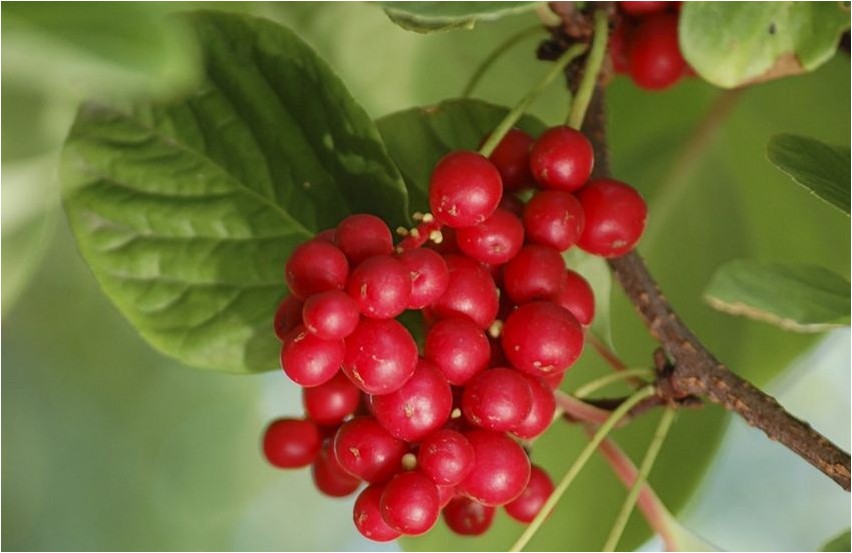
Schisandra (lat. Schisandra) is a woody vine from the Limonaceae family. The second (Russian) name of this plant is lemongrass.
Description
Schisandra is either a deciduous or climbing evergreen shrub with entire, short-petioled leaves. The shoots of this plant are covered with yellowish, smooth bark. The obovate or elliptical leaves of schizandra reach three to five centimeters in width and five to ten centimeters in length. Their bases are wedge-shaped, and their tips are pointed. A very pleasant lemon aroma emanates from both the stems and leaves of schizandra!
Dioecious schizandra flowers reach one and a half centimeters in diameter and boast a fairly pronounced aroma. At first they are white, but towards the end of flowering they often turn pink. The flowers of this plant are dioecious, and in some years only male flowers can form on schizandra. And when all the flowers have faded, the receptacle gradually begins to grow, and in the place of each flower a cluster of racemes is formed, the length of which can reach up to ten centimeters. And each polyberry, in turn, is formed by a fairly large number of red, juicy berries.
In total, the genus of schizandra includes fourteen independent species.
Where does it grow
The homeland of schizandra is considered to be East Asia and the Far East. And on the territory of Russia only one species is found — Chinese lemongrass.
Usage
Schizandra is quite widely used in ornamental gardening — it can easily decorate even the most inconspicuous area!

The edible fruits of schizandra boast a fairly high content of vitamins. And they make wonderful jams and jelly! By the way, the Chinese called lemongrass fruits “fruits with five tastes”! And all because their shells are sweet, the pulp is characterized by a sour taste, the seeds can be both bitter and tart at the same time, and all kinds of potions prepared from these seeds acquire a salty taste during storage.
Eastern medicine places schizandra in second place after the well-known ginseng — its fruits perfectly help relieve fatigue, not only physical, but also mental. And they have also proven themselves very well in curing a number of different ailments!
Growing and care
Schizandra boasts good shade tolerance and average requirements for moisture and soil fertility, but it will grow best in well-drained, moist soils. At first, young plants develop well in the shade, but as they grow, especially closer to the fruiting stage, they are characterized by an increased need for light — at least the tops of the shoots should already be in the sun by this time. Ideally, you should try to plant this plant in such a way that its base is in the shade and its apical parts are in the sun. And excess shoots that thicken the plantings too much must be cut out in late autumn or winter.
In summer, this plant responds very well to spraying with water and foliar feeding. And with the onset of autumn, Schizandra also requires abundant watering. Around the same time, it should be mulched with dry leaves or peat — this approach will provide reliable protection for the roots of the plant.
Schizandra can be propagated either by root suckers or seeds, or by dividing bushes, layering, or green cuttings, but the latter method of propagation is not often used. The easiest option is to propagate this beauty by root shoots (as a rule, this is done in early spring): after two or three years, the first fruits can be collected from the trees!





