Centaury meyeri
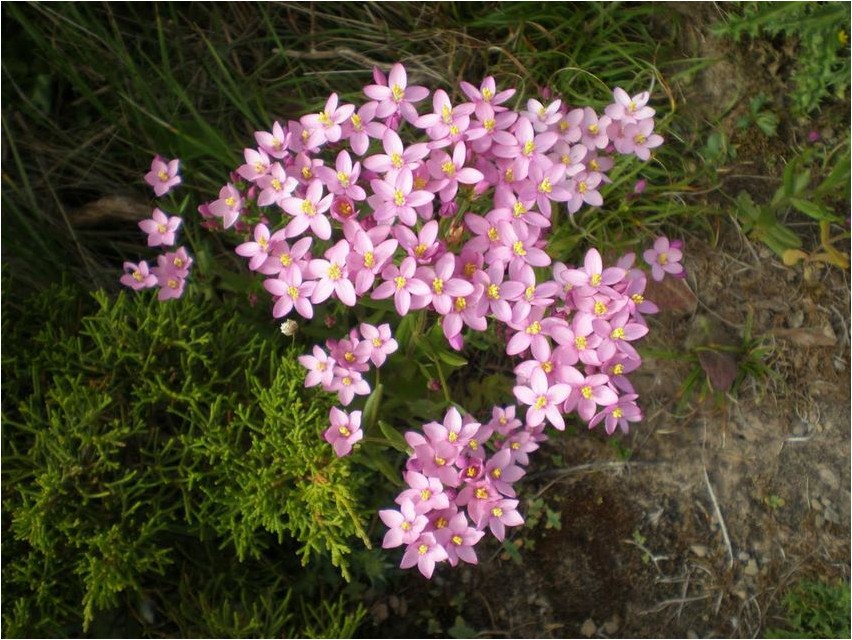
Centaury meyeri is a member of the Gentianaceae family. Its Latin name is Centaurium meyeri (Bunge) Druce.
The Latin name for the centaury family is Gentianaceae Juss.
Description of Centaury meyeri
Centaury meyeri is an annual, leafless, light-green plant, growing between ten and forty centimeters in height. Its stems are tetrahedral, branching either above or below the midpoint. The cauline leaves are ovate or oblong-linear, vaguely trifoliate and pointed, and can be somewhat elongated or very narrow at the apex of the inflorescence. The inflorescence of the meyer centaury has several splayed peduncles. The flowers of this plant are white. The fruit of the meyer centaury is a capsule, almost unilocular, but also oblong-linear. The seeds of this plant are very small, irregularly rounded, and dark brown.
The meyer centaury blooms from May to October. In the wild, the plant is found in the Altai region of Western Siberia, the Black Sea region of Ukraine, Central Asia, Crimea, and the following regions of European Russia: the Black Sea region, the Volga region, and the Lower Don region. In terms of its general distribution, the plant can be found in Manchuria and northwest China. The plant prefers floodplains, forest clearings, river floodplains, forest edges, marsh edges, alkaline soils, and shrub thickets.
Description of the medicinal properties of Centaury meyerii
Centaury meyerii has quite valuable medicinal properties. For medicinal purposes, it is recommended to use the herb, which should be harvested during flowering. The herb includes the stems, leaves, and flowers.
Preparations based on this plant can improve appetite and enhance gastrointestinal function, and will also reduce gastric acidity and improve digestion. These preparations have carminative, mild laxative, choleretic, wound-healing, analgesic, and antiseptic effects.

In folk medicine, Meyer’s centaury is used for various gastrointestinal ailments: heartburn, gastritis, and gastric and duodenal ulcers with increased gastric acid secretion, as well as loss of appetite, dysentery, flatulence, dyspepsia, scrofula, vomiting, and kidney, liver, and gallbladder diseases. The plant is also used for various heart conditions, diabetes, to improve circulation, and as a restorative and tonic for numerous skin conditions and after serious illnesses.
A decoction made from ten to fifteen grams of Meyer’s centaury is used for hepatitis, headaches, fever, tonsillitis, toothache, and gallbladder inflammation. To improve appetite and treat various gastrointestinal ailments, use the following remedy based on this plant: To prepare this remedy, take fifteen grams of crushed centaury herb and pour a glass of boiling water over it. Let the mixture steep for thirty minutes, then strain and add honey or sugar to taste. Take one tablespoon three times daily, half an hour before meals.
Centaury. This plant will cleanse the body of poisons and toxins!!!





