Roicissus
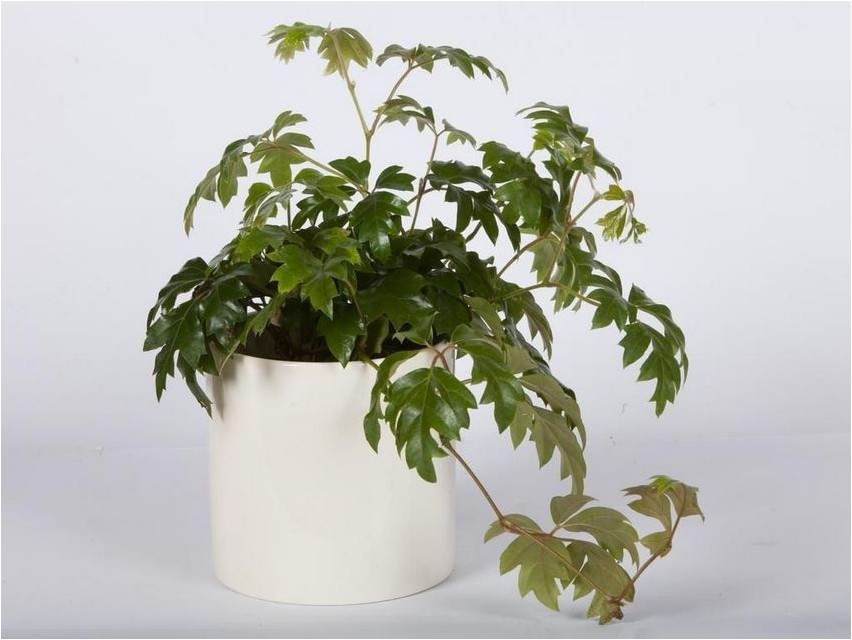
Roicissus (lat. Rhoicissus) is a flowering plant belonging to the Grape family.
Description
Roicissus is an evergreen climbing shrub or climbing vine, equipped with amazingly beautiful decorative leaves. The stems of the plant are long and branching. Young shoots are impressively elastic, but over time they gradually become woody. The leaves of Rhoicissus are dark green, and their undersides have a rather attractive brownish tint. They sit on petioles of medium length, and their simple leaf plates can have the appearance of buds or be round. There are also varieties in which the leaf blades are endowed with wide bases that look like a heart. The leaves below, especially young ones, are always pubescent, and on top they are usually smooth and have a light, not very pronounced shine. The edges of the leaves are equipped with fairly large teeth. In addition to the dense foliage, on the rhoicissus you can also see a great many antennae, also densely covered with microscopic hairs. With these tendrils, plants cling to supports, completely wrapping around them after some time.
The inconspicuous small flowers of rhoicissus form small inflorescences, and its cute, medium-sized fruits are round in shape — these reddish-purple berries are quite often processed for subsequent consumption.
The small genus of roisissus has only a little more than a dozen varieties.
Where does it grow
Roicissus grows mainly in South African territories. Quite often it can be found in the tropics of Laos or Vietnam.
Usage
Most often, rhoicissus is used as a climbing plant on trellises or as an ampelous plant in hanging or wall vases.

The leaves of some varieties of rhoicissus have found their use in traditional medicine. And the edible berries of this plant are often eaten.
Growing and care
Roisissus should be grown in light areas, providing it with proper shading from the scorching rays of the sun (otherwise its leaves will quickly turn yellow). This plant tolerates shading very well, so do not be afraid of it. In winter, it is advisable to maintain the temperature of the roisissus within fifteen degrees maximum, although slightly higher temperatures are also quite acceptable.
Roisissus needs to be watered frequently, especially in the summer season, since it not only grows very quickly, but is also endowed with a huge number of leaves with a very impressive evaporating surface. Regular spraying with water will also benefit him. In addition, in the summer it is recommended to systematically feed roisissus with complete fertilizers — this will help accelerate its growth.
With the onset of spring, it is advisable to transplant the plant into a mixture formed by turf soil with humus in combination with peat and sand (it is important to maintain the proportion of 2:1:1:1/2).
Roicissus can be propagated by apical cuttings throughout the year, but if mass propagation is necessary, it is best to take stem cuttings with eyes (one or two). If you provide the moss with sand or peat in which the cuttings were planted with proper soil heating (that is, a temperature in the range of twenty to twenty-two degrees), their rooting will occur within fifteen to twenty days. By the way, several cuttings can be planted in one pot at once, after which the pots are often transferred to greenhouses until they form roots.