Thyme
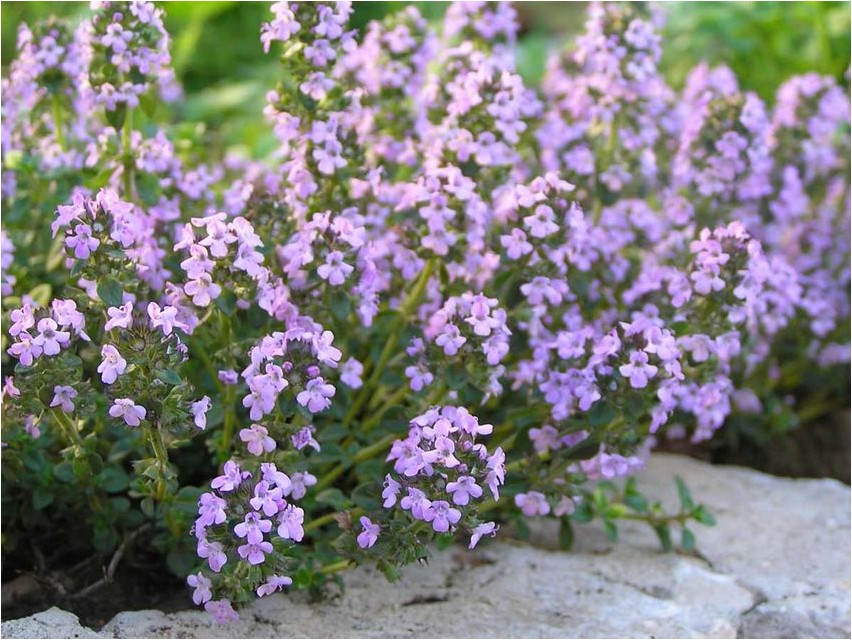
Thyme (lat. Thymus) is a genus of essential oil subshrubs or dwarf shrubs of the Lamiaceae or Lamiaceae family. The plant is popularly known as thyme, lemon scent, heather, Bogorodskaya grass, flypalm, boron pepper, zhidobnik, incense, chebarka, and lebyushka.
Natural range – North Africa, Greenland, regions of Europe and Asia, except the tropics. About 170 species grow on the territory of the Russian Federation alone. Thyme grows in a wide variety of environmental conditions: in forest glades and forest edges, pine forest sands, in steppes, on rocky slopes and rocks.
Characteristics of culture
Thyme is a low-growing subshrub or shrub up to 35 cm high, possessing ascending or recumbent stems, sterile shoots and ascending or erect herbaceous flowering branches. The root system is taprooted and woody. The stems are branched, woody at the base, covered with erect hairs bent down over the entire surface. The leaves are small, round, ovate or linear-oblong, leathery, hard, sessile or short-petiolate, opposite, entire, less often jagged, with pronounced veins.
The flowers are small, collected in elongated, whorled or capitate inflorescences located at the ends of the branches. The calyx is narrowly bell-shaped or cylindrical, hairy on the outside. The corolla is white, pink or purple, two-lipped. The upper lip is wide, half-lobed, the lower lip is bifid to the base. The fruit is a capsule. The seeds are spherical or ellipsoidal, black-brown in color. Thyme blooms in June-August, the fruits ripen in August-September. Thyme has a pleasant aroma and a slightly pungent and bitter taste. The plant is a good honey plant.
Growing conditions
Soils for growing thyme are preferably light or medium, fertile, drained, neutral or carbonate. The culture does not accept acidic, waterlogged and heavy clay soils. Thyme is photophilous and grows well in open sunny areas. Light shadow is not forbidden. The best predecessors are vegetable crops, under which manure was applied.
Reproduction and planting
Thyme is propagated by seeds, cuttings and dividing the bush. The third method is more effective and simpler. To do this, the mother bush is dug up, disassembled into sections with roots and planted in the ground in a permanent place or for growing. Compact subshrubs are most often propagated from cuttings. Lignified annual cuttings 3-5 cm long are cut in the spring, after which they are planted in a greenhouse for rooting. It is important to avoid overmoistening, as this can negatively affect the planting material. As a rule, cuttings take root in 2-3 weeks.

The seed method also does not cause any particular difficulties. Seeds are sown immediately in the ground or in a greenhouse. Thyme seeds are very small, so the seedlings are hardly noticeable, so it is necessary to carefully monitor their development, otherwise the weeds will choke out the young plants.
Growing thyme in seedlings is not prohibited. In this case, the seeds are sown in March-April. The substrate for seedlings is prepared from light and moisture-permeable soil, sand and peat in a ratio of 2:1:1. Sow seeds in pre-prepared grooves. Planting depth is 0. 5-1 cm. Under optimal maintenance conditions, seedlings appear in 7-10 days. Seedlings are planted in the ground at the end of May. At the age of two months, the plants form compact bushes, some of them bloom in the first year towards the end of the season.
Care
Thyme does not need fertilizing; at best, you can add horn flour or rotted compost to the stem zone. Watering is rare and plentiful; during drought, their quantity increases. Watering is especially necessary during the active growth of young shoots and flowering. The crop requires pruning, which is carried out in early spring or immediately after flowering. Pruning allows you to form dense and compact bushes. Thyme is resistant to diseases and pests.