Chard
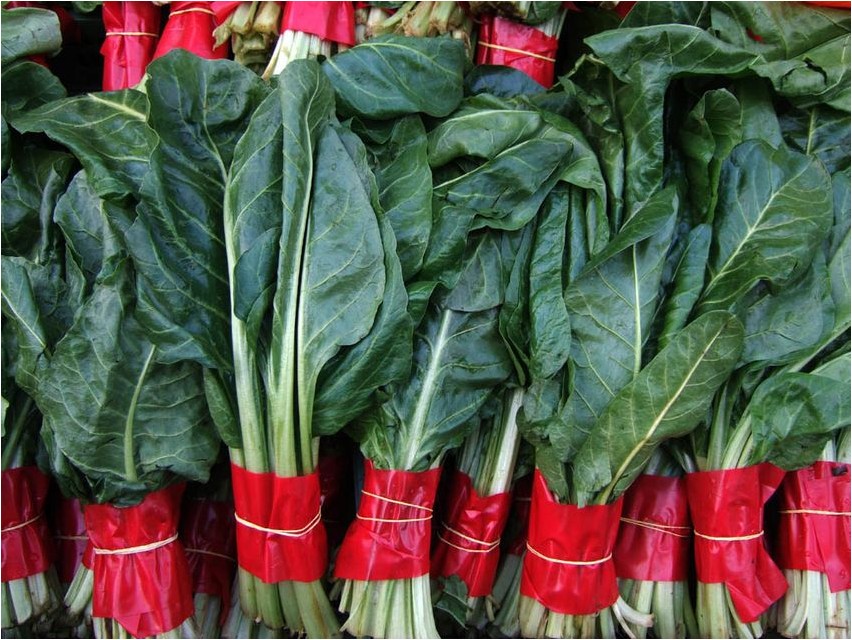
Chard, or chard (lat. Beta vulgaris) is a biennial plant of the Chenopodiaceae family. The closest relative of sugar beet, fodder beet and common beet.
In appearance, chard is similar to spinach. As a vegetable plant, maggold is widely distributed in Latin America, Central and Western Europe, North Africa, as well as Mexico, India, the USA, Japan and other countries.
Characteristics of culture
Chard is a herbaceous plant with long stems and leaves. In the first year of life, the crop forms a large rosette of leaves and a highly branched, slightly thickened root. In the second year, the plants form flowering stems, and subsequently seeds. The leaves are smooth, bubbly or curly, the stems are white, yellow, light green, dark green or red.
Today, there are two main forms of chard: chard (lat. Beta vulgaris subsp. vulgaris var. vulgaris convar. vulgaris) and stem or veined chard (lat. Beta vulgaris subsp. vulgaris var. vulgaris convar. flavescens). Schnitt chard is characterized by increased frost resistance; even after cutting the leaves, it produces a new harvest. Stem chard can only be identified by the prominent white or reddish veins on the stem.
Growing conditions

High yields of chard leaves are obtained only on light, fertile soils with a neutral pH reaction. The crop grows especially well on plains, the soil of which allows plant roots to freely develop into the depths. In general, chard is not demanding and easily adapts to different climates and soils. The plants do not accept dense plantings. The optimal distance between plants of leafy forms is 25 cm, between petioles — about 50 cm. It is not forbidden to grow chard in close proximity to carrots, lettuce, onions, and various types of cabbage, but it is not recommended to plant spinach next to it.
Sowing
Beetroot is grown by sowing seeds in open ground or through seedlings. The seeds are sown in a row with an interval of 45 cm. The sowing rate is 1013 g per 10 square meters. Planting depth is 2-3 cm. The crops are sprinkled with humus or peat, this procedure allows for earlier shoots.
Winter forcing
Chard can also grow on a windowsill without any problems. At the end of September, or rather before the onset of stable frosts, the roots of the plant are carefully dug up and transplanted into a heated greenhouse or into pots. the room temperature should be at least 20-22C. The first cutting of leaves is carried out after 25-30 days.
Care
The first thinning is carried out with the appearance of 2-3 true leaves on the seedlings, the distance between plants should be about 15 cm. The second thinning implies an interval between plants of petiole varieties — 40 cm, leaf varieties — 25 cm. After thinning, the chard is fed with ammonium nitrate, potassium salt and superphosphate. Further care consists of systematic weeding, loosening the rows and watering.
Pest and disease control plays a very important role for leaf beets. Young plants are often damaged by the root beetle, the causative agent of diseases; if not treated in a timely manner, the plants turn black, wither and die. The disease develops on heavily waterlogged soils. Chard is often affected by spotting and downy mildew. The most important preventive measure is compliance with all rules of care and growing conditions.
Harvesting and storage
Harvesting of leaf forms of chard begins 60-70 days after emergence, by which time the plants have formed at least 5-7 large leaves. Several cuts are made during the season, since the leaves grow back very quickly. Harvesting of petiole forms of chard begins 90-100 days after germination. Store chard leaves and petioles in boxes. Lay them in a thin layer.





