Peperomia shriveled
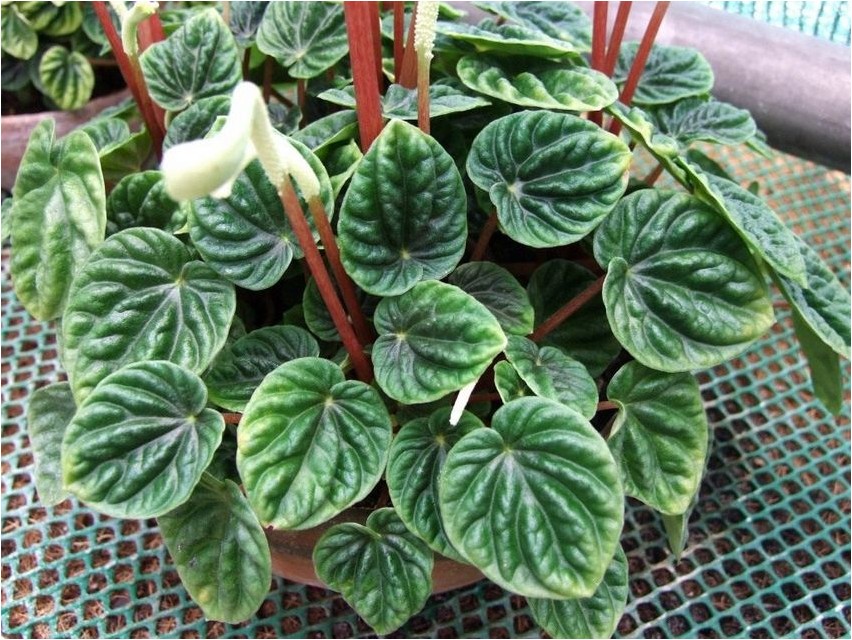
Peperomia caperata is one of the plants of the family called pepper; in Latin the name of this plant will be as follows: Peperomia caperata.
As for the name of this family itself, in Latin it will be like this: Piperaceae.
Description of peperomia corrugata
For favorable cultivation of peperomia corrugata, it is important to provide the plant with either partial shade or sunny light conditions. As for watering, throughout the entire summer season it is important to ensure abundant watering, and air humidity should be average. The life form of Peperomia corrugata is a herbaceous plant.
This plant is quite common in indoor culture, and the plant should be grown either in indoor greenhouses or in closed display windows. In addition, quite often this plant can also be found as part of hanging compositions. Also, corrugated peperomia is used for landscaping epiphytic trunks, and as a ground cover plant, corrugated peperomia can be found in greenhouses or winter gardens. As for the maximum size in culture, the height of wrinkled peperomia can reach ten centimeters.
Description of the features of care and cultivation of peperomia corrugata
To grow Peperomia corrugata, replanting should be done regularly, approximately every two to three years. For replanting, you should select either fairly wide bowls or standard-sized pots. In addition, the following soil soil will be required: the same ratio of turf soil, leaf soil and peat, as well as half of this ratio of sand. The acidity of such a substrate should be slightly acidic. As for the variegated forms of peperomia corrugata, in order to preserve their decorative effect, the plant should be kept in bright but diffuse lighting. It is important to remember that if you want to increase the bushiness of this plant, you will need to regularly prune and pinch the shriveled peperomia. It is also important not to allow the soil to become overly moist: otherwise, the leaves of the plant will begin to rot, and the plant itself will subsequently die. In some cases, damage to peperomia wrinkled by mealybugs occurs.
Throughout the entire dormant period of this plant, it is recommended to maintain the temperature at the following level: from thirteen to eighteen degrees Celsius. Watering should be provided to this plant moderately. The rest period begins in October and continues until February; this period is forced, and its occurrence is due to the fact that air humidity and the degree of lighting will be insufficient.

Peperomia corrugata propagation occurs through apical, leaf and stem cuttings, however, the soil temperature should be around twenty to twenty-five degrees Celsius. In addition, propagation can also occur by dividing the bush, which should be done during transplantation. Peperomia corrugata is rarely propagated using seeds.
It is important to take into account the fact that for the favorable development of this plant, the difference in air temperature and soil temperature should be no more than a couple of degrees. In this case, air humidity must be constantly maintained at sixty percent. Regular spraying has a beneficial effect on the development of this plant, and preference should be given to water that has a low lime content.
Both the flowers and leaves of Peperomia corrugata have decorative properties. The flowers of the plant are painted in delicate white tones. It is worth noting that the flowers are located in inflorescences-cobs, which are shaped like mouse tails.