Lepidium densiflorum
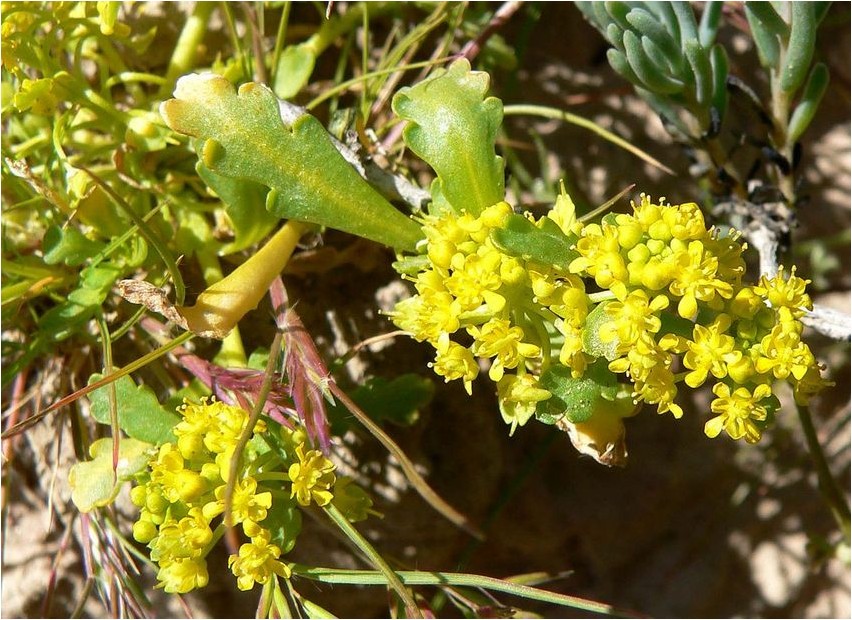
Lepidium densiflorum is a member of the Brassicaceae or Cruciferae family. Its Latin name is Lepidium densiflorium.
The family name of Lepidium densiflorum is Brassicaceae Burnett (Cruciferae Juss.).
Description of Lepidium densiflorum
Lepidium densiflorum is an annual or biennial herbaceous plant, growing approximately ten to fifty centimeters tall. Its stems are covered with pubescent, capitate hairs. The basal leaves of Lepidium densiflorum are oblong and can be either pinnately incised or pinnately dissected into entire or incised-toothed lobes. The upper leaves of this plant are linear, and can be either coarsely serrated or entire at the top. It should be noted that the flowers of this plant are very small and often underdeveloped.
Blooming occurs from May to August. In the wild, this plant is found in European Russia, the Far East, Belarus, Central Asia, Ukraine, and Western and Eastern Siberia. It prefers roadside locations, garbage dumps, steppes, pastures, alkaline areas, riverbanks, conglomerate outcrops, among conifers, on rocky and gravelly slopes, and in the mountains up to the upper alpine zone. Description of the medicinal properties of Lepidium densiflorum
Lepidium densiflorum is endowed with very valuable medicinal properties, and it is recommended to use the herb of this plant for medicinal purposes. The herb includes the flowers, leaves, and stems of this plant. These valuable medicinal properties are explained by the alkaloids and flavonoids found in the above-ground parts of the plant: kaempferod glycosides and quercetin. The seeds of this plant contain fatty oil and the following acids: oleic, palmitic, linoleic, erucic, eicosenoic, arachidic, behenic, and stearic.
Decoctions and infusions prepared from this herb are recommended in folk medicine for malaria and fever as a highly effective antipyretic.
At a temperature, it is recommended to use the following remedy based on the bug plant: to prepare such a remedy you will need to take about eight to ten grams of the herb of this plant per three hundred milliliters of boiling water. The resulting mixture should be boiled over fairly low heat for about four to five minutes in a sealed container, then the mixture is left to steep for one hour, after which the mixture is filtered very carefully. Take the resulting remedy based on the bug plant in a warm form three times a day, one-third of a glass.

At high temperatures, it is recommended to use the following very effective remedy based on this plant: to prepare such a remedy you will need to take one teaspoon of seeds per glass of boiling water. It is recommended to infuse the resulting mixture in a sealed container for two hours in a warm place, and then filter the mixture very carefully. Take the resulting remedy, based on the bug plant, three to four times a day, one to two tablespoons. It is important to follow all preparation standards and rules for taking such a product: only in this case will the desired effect be achieved.
“Fleabag” (“Klopovnik”, “Fleabag”) \ Psychological analysis of the series





