Tamarix
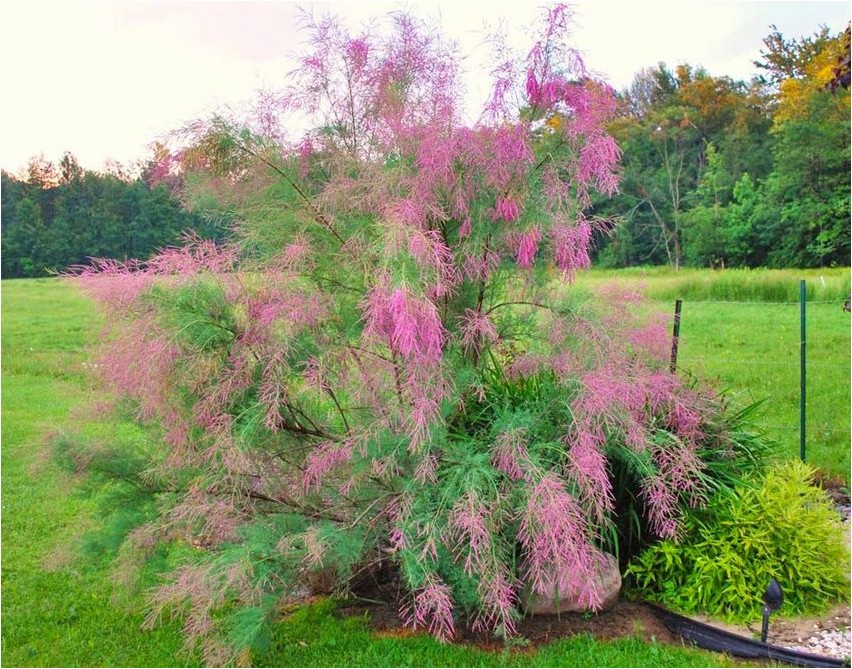
Tamarix (lat. Tamarix) is a light-loving woody plant from the Tamarix family. Its second name is the comb tree, and in some Russian regions it is also called the bead tree or the tree of God.
By the way, in ancient times, tamarix was considered one of the most important sacred trees among the ancient Sumerians!
Description
Tamarix are spectacular shrubs or low evergreen or deciduous trees that can boast luxurious spreading crowns. Numerous twig-like thin shoots of this plant are densely dotted with tiny bluish-greenish leaves. The small scaly leaves of tamarisk fit quite tightly to the strong needle-shaped branches, due to which sometimes this plant is very reminiscent of cypress.
Miniature pink, white or purple tamarisk flowers form extremely attractive racemes.
Currently, more than seventy-five varieties of tamarix are known.
Where does it grow
The habitat of Tamarix is quite extensive — it can be found from India to Southern Europe. This plant is also found in Russia — five of its varieties grow here. Most often, tamarix can be seen in steppes, semi-deserts or deserts in Asia, Africa and southern Europe.

Usage
In the southern regions, tamarix is widely used for landscaping. However, this is one of the best rocks not only for decoration, but also for fixing loose sand. Tamarix will look equally good in parks, squares, and alleys.
Tamarix also has many admirers in central Russia — here it is used to create delightful, constantly flowering thickets, and if properly planted with regular pruning, they are used to form amazingly beautiful hedges.
As for the small branches of tamarisk, as well as the marvelous inflorescences of this plant, they have also proven themselves excellent in cutting. And this plant also looks great in single plantings!
Young tamarisk branches are eaten by livestock with great pleasure, and in the autumn the branches of this plant acquire a strong laxative effect, which, if necessary, can always be taken into account. And this handsome guy is also an excellent pergonos!
As for the wood of tamarisk, this plant is very dense and boasts incredibly beautiful patterns, however, due to the fact that very large trees are not so common, it is used mainly for carving and turning, as well as for making small crafts. And overgrown specimens aged from four to seven years are often used as fuel.
Growing and care
Tamarix grows well in nutritious and fairly light soils. In general, this beauty is completely unpretentious to soils — if you plant it on poor, saline soils, it will also grow well, since Tamarix is characterized by a fairly high salt tolerance. It is important to take into account that this plant is not only light-loving, but also very heat-loving, although some of its varieties are characterized by very impressive winter hardiness.
Tamarix tolerates transplants and haircuts very easily, and its propagation usually occurs either by shoots or with the help of cuttings, especially green ones. In addition, small sections of branches of this plant are often rooted in water on windowsills in winter. Tamarix can also be propagated by seeds — they can also boast of fairly good germination.