Soybeans
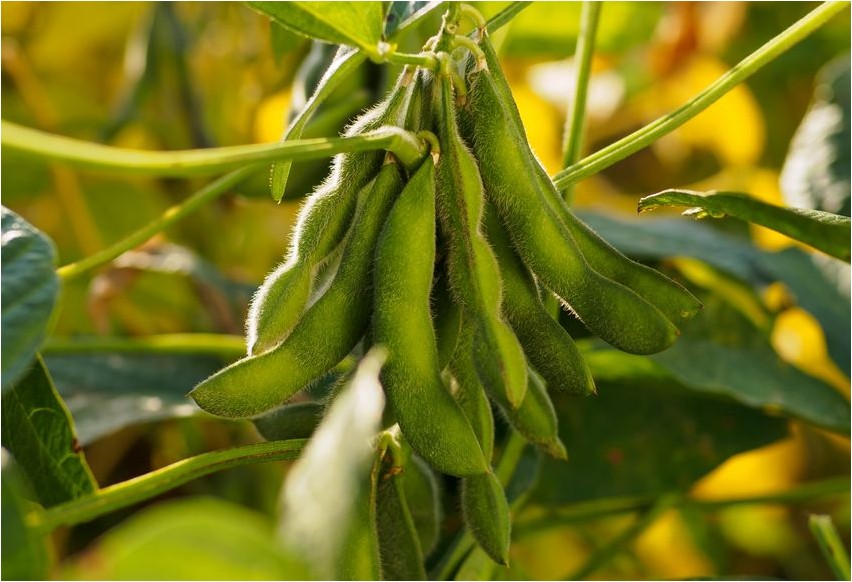
Soybean (lat. Glycine max) is a herbaceous annual from the well-known legume family.
History
Soybean is rightfully considered one of the oldest crops, as it has been cultivated for more than five thousand years. It first appeared in China: turtle shells, bones and stones were decorated with soybean designs. And then this culture gradually penetrated into Korea and the Japanese islands.
Description
Soybean is a plant endowed with bare or pubescent stems, which can be either quite thick or very thin. And their height can vary from fifteen centimeters to two meters.
Trifoliate soybean leaves are characterized by pinnate venation and clearly visible pubescence. And on the first epicotyledonous node two simple primordial leaves sit firmly.
The corollas of soybean flowers can be colored either white or a wide variety of purple shades. As for its fruits, they look like beans, containing two or three seeds and opening with both valves along both the dorsal and ventral sutures. All beans are very resistant to cracking and are quite large in size — their size ranges from four to six centimeters.
Oval soybean seeds can have completely unequal convexity. And the sizes of seeds often differ radically — they can be both small and very large.

Where does it grow
Huge soybean plantations are located in South and North America, on the islands of the Indian and Pacific Oceans, as well as in Australia, Southern Europe and Asia. This crop grows very well in South or Central Africa.
Application
Soy is actively used as a healthy and relatively inexpensive substitute for a number of dairy products and meat, and is also often added to feed intended for young farm animals. It is also an indispensable component for vegan nutrition.
How can we explain the fact that soy can easily turn into a wonderful sausage, delicious pate or aromatic meat stew? The fact is that it is endowed with the ability to instantly absorb almost any tastes and aromas. And since this culture does not have its own aroma and taste, it can easily replace various products.
Thus, the incredible popularity of soybeans is due not only to the fact that it is very rich in protein and boasts excellent yield, but also because it is endowed with truly unique properties that make it possible to obtain a wide variety of products from it. Soy contains B vitamins, potassium, calcium and iron, as well as essential polyunsaturated fatty acids such as linolenic and linoleic acids.
The health benefits of soy should not be underestimated. People who regularly use this product are unlikely to experience allergies, osteoporosis, obesity or coronary heart disease. In addition, soy significantly reduces the risk of developing dysbiosis and cancer and even helps increase life expectancy.
True, everything is good in moderation, and you shouldn’t overuse soy products either. If you ignore this rule, especially for children, they can easily stop growing or develop insufficiency of thyroid function. Also, abuse of products containing soy can lead to conjunctivitis, colitis, diarrhea, eczema, bronchospasms, asthma, dermatitis, rhinitis, urticaria and a whole range of other ailments. And this can also significantly harm the kidneys. And since soy proteins provoke all sorts of hormonal changes in the human body, it is important for pregnant women to try to avoid including any soy products in their diet.