Seaside eryngium
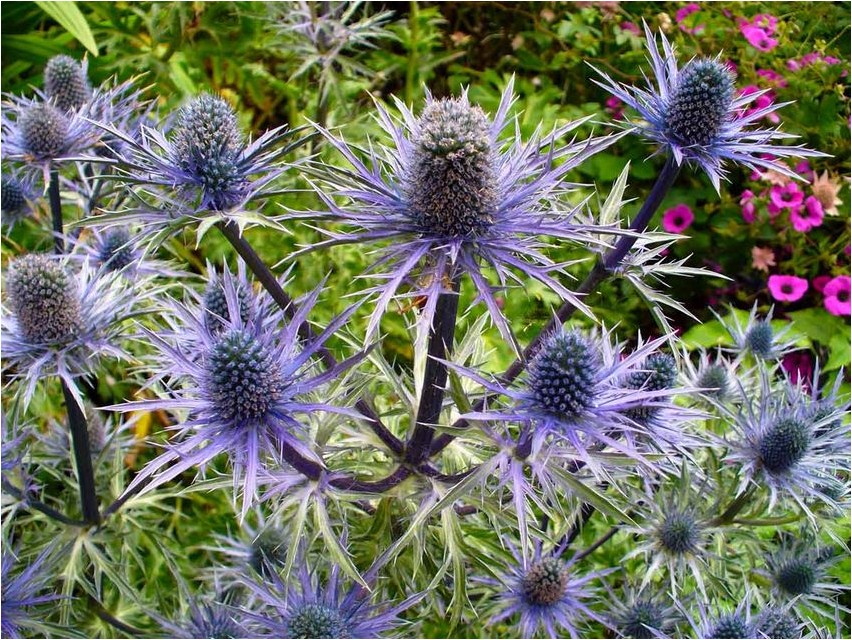
Eryngium maritimum is one of the plants of the family called Umbellaceae; in Latin the name of this plant will be as follows: Eryngium maritimum L.
As for the name of the seaside eryngium family itself, in Latin it will be: Apiaceae Lindl. (Umbelliferae Juss.).
Description of the seaside eryngium
Bluehead is an erect perennial herbaceous plant, colored in bluish-green tones. The height of such a plant will fluctuate between forty and sixty centimeters. The leaves of the eryngium eryngium are leathery, and the edges of such leaves will be endowed with large, spiny teeth. The lower leaves of this plant will be petiolate and cordate-reniform, while the upper leaves are almost palmately lobed and stem-encompassing. The inflorescence of the seaside eryngium is a spherical head endowed with an involucre, which in turn will consist of five to eight large ovoid spiny bracts. The calyx of this plant consists of five spiny teeth, the corolla is five-petalled, and the petals will be notched and bluish in color. These petals have a long tip that is curved inward. There are only five stamens of the eryngium erygum, the bilocular ovary is the lower one, and there are only two styles. The fruit of this plant is an oval-shaped achene, which is covered with scales.
Under natural conditions, the seaside eryngium is found in the Caucasus, Crimea, as well as in the following regions of the European part of Russia: Lower Don, Baltic and Black Sea. For growth, this plant prefers places near rocks and sandy and pebble seashores.
Description of the medicinal properties of eryngium.
The seaside eryngium is endowed with very valuable healing properties, and it is recommended to use the roots and herbs of this plant for medicinal purposes. The term grass includes flowers, stems and leaves.
The presence of such valuable healing properties should be explained by the content of glucose, fructose, coumarins, flavonoids, oxalic, malic, malonic and glycolic acids in this plant, as well as phenolcarboxylic acids and their derivatives: rosmarinic and chlorogenic acids. The fruits of the eryngium sage contain fatty oil.

Infusion and decoction prepared from the herb of this plant should be used for kidney stones and ascites, and also used as a lactogenic, diuretic, analgesic and diuretic.
For kidney stones, it is recommended to use a decoction prepared from the roots and herbs of eryngium. Also, such a drug is effective in enhancing sexual function. In the Caucasus, for pulmonary tuberculosis, it is recommended to use a decoction based on the roots of this plant.
It is noteworthy that the leaves and young shoots of the eryngium are edible and can be used as asparagus and salad.
For flatulence, it is recommended to use the following very effective medicinal remedy: to prepare such a medicinal product, you will need to take two teaspoons of crushed roots of the eryngium erygium per 300 milliliters of water. The resulting mixture should first be boiled for about five to six minutes, then it is left to infuse for one hour and filtered very carefully. Take this medicine based on eryngium erygium, three to four times a day, one-third of a glass.





