Plantain pinnata
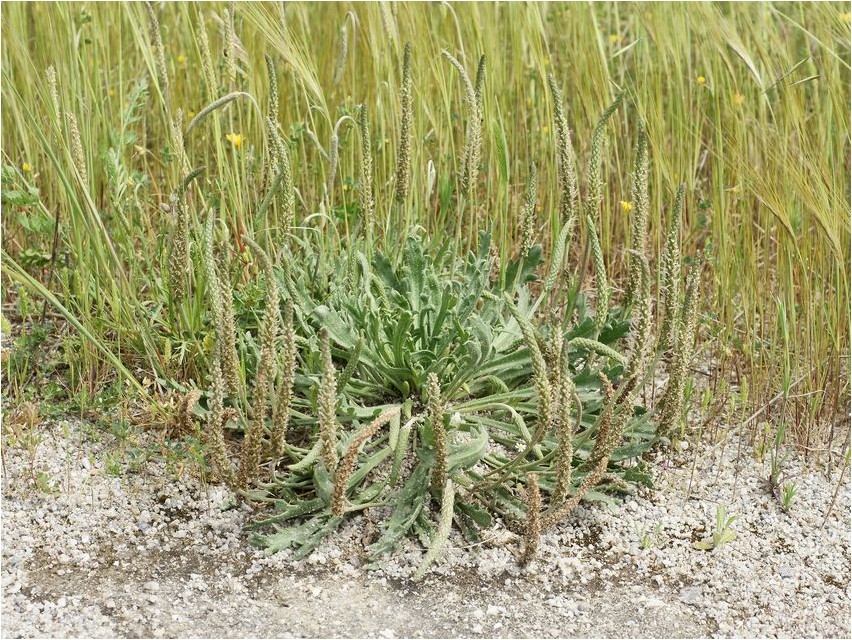
Plantago pinnata is a member of the plant family Plantaginaceae. Its Latin name is Plantago coronopus L.
The family name of Plantain pinnata is Plantaginaceae Juss.
Description of Plantain pinnata
Plantago pinnata is an annual herbaceous plant, reaching heights between two and forty centimeters. This plant will bear several or multiple flower stalks. The leaves of Plantain pinnata are narrow, linear, and have narrow lateral lobes or teeth, although sometimes these leaves may be entire. The inflorescences of this plant are narrow, cylindrical, and covered with appressed hairs. The corolla lobes of the common plantain can be either oblong-ovate or ovate, measuring approximately one millimeter. The fruit of this plant is a three- to five-seeded capsule; the seeds themselves are biconvex and elliptical, and are brown in color.
In the wild, this plant is found in Central Asia, Eastern Transcaucasia, and Dagestan in the Caucasus, as well as in Crimea. Common plantain prefers coastal areas, dry slopes, sand, salt licks, and pebbles.
Description of the medicinal properties of common plantain
Common plantain has very valuable medicinal properties, and the entire above-ground portion of this plant is recommended for medicinal purposes. The presence of such valuable medicinal properties is believed to be explained by the presence of higher fatty acids and the following steroids in the roots of this plant: sitosterol, cholesterol, campesterol, and stigmasterol. The seeds of the common plantain contain tannins, steroids, the iridoid aucubin, saponins, and a fatty oil containing lipoic, oleic, and linolenic acids.
An infusion made from the aerial parts of this plant is recommended for diarrhea, and also serves as a diuretic, hemostatic, and detoxifying agent for rabid dog bites.

The leaves of this plant are suitable for various salads.
For food poisoning, the following highly beneficial remedy based on this plant is recommended: To prepare this highly effective remedy, take one tablespoon of crushed plantain leaves per glass of boiled water. The resulting healing mixture should be steeped for approximately one hour, after which it should be thoroughly strained. Take this plantain-based remedy three to four times daily, one to two tablespoons approximately fifteen to twenty minutes before meals. It should be noted that to ensure maximum effectiveness, it is important not only to strictly follow all the instructions for taking this plantain-based remedy, but also to strictly adhere to all the preparation instructions. In this case, if taken correctly, this herbal remedy will be very effective, and the positive effect will be noticeable quite quickly. However, the degree of effectiveness will be directly dependent on the intensity and severity of the poisoning. Plantain feathery plantain