White anemone
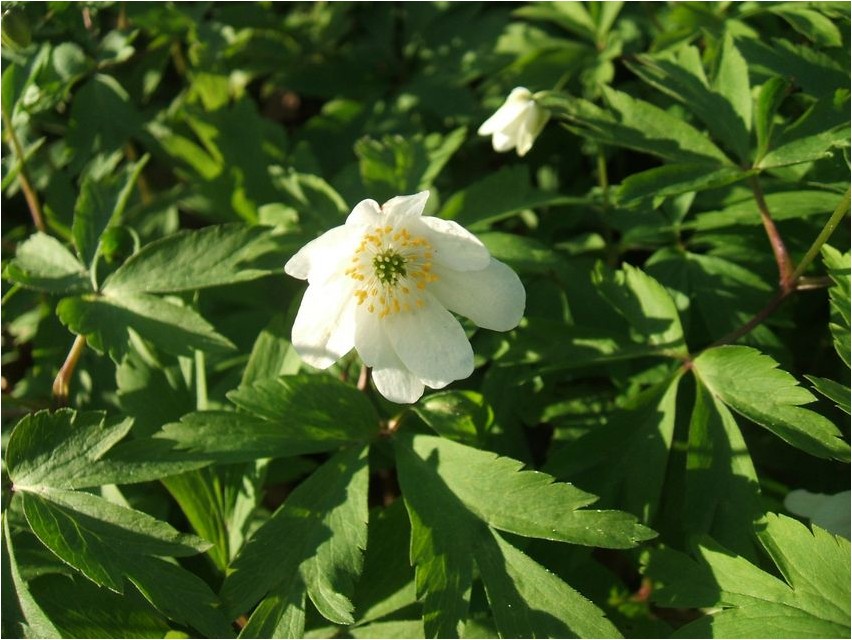
White anemone is one of the plants of the family called Ranunculaceae; in Latin, the very name of this plant will sound as follows:
Anemone nemorosa L. As for the name of the family, in Latin it will be: Ranunculaceae Juss.
Description of white anemone
White anemone is a perennial herbaceous plant. The height of this plant can vary between six and thirty centimeters. The rhizome of this plant is horizontal, smooth and cylindrical. The color of the rhizome of the white anemone can be either brown or yellowish. The root leaves will most often be single, they are on long petioles and will be three-parted, they have short-petiolate segments: the lateral ones will be bipartite, and the middle one will be three-parted.
The stems of white anemone are erect, bare or sparsely hairy. The leaves of the bedspread are on long thin petioles, and their length will be about one to two centimeters. Most often, the peduncles are single, long and appressed. The diameter of the flowers of this plant will be about four to four and a half centimeters, the flowers will be oblong-ovoid in color, white, on the outside these flowers will be reddish-violet in color. On both sides there are bare tepals; it is noteworthy that the stamens are many times shorter than the tepals, and the anthers themselves are colored yellow. The length of the fruitlets will be about four and a half to five millimeters, such fruitlets are oblong and also short-haired, their nose will be short and slightly curved. This plant blooms from about April to May.
White anemone can be found quite often in both Belarus and Moldova, the European part of Russia and Ukraine in the Carpathians and the Dnieper region. This plant chooses to grow in damp forests, bushes, lawns, parks and forest edges. This plant is not only amazingly decorative, but also quite poisonous.
Description of the medicinal properties of white anemone
This plant possesses valuable medicinal properties, and the white anemone herb—its flowers, leaves, and stems—is used for medicinal purposes. It’s worth noting that the plant has a relatively high content of chelidonic acid and saponins. White anemone flowers contain protoanemonin. It is precisely these substances that give the plant its valuable medicinal properties. In homeopathy, this plant is widely used as a diuretic, diaphoretic, and sedative.

An infusion made from white anemone herb is particularly effective when taken internally. This remedy is recommended for a variety of heart conditions, pneumonia, stomach pain, and fever. It’s also worth noting that the herbal infusion can also be used as an abortive. Externally, an infusion of white anemone herb is recommended for various pustular skin conditions, as well as gout and rheumatism. Among other things, an infusion of this plant’s herb is also used as a blistering agent. It’s worth noting that, in addition to all its other benefits, this plant also has quite effective antibacterial properties.
For rheumatism, the following remedy is recommended: to prepare it, take one teaspoon of the herb per cup of boiling water. Let this mixture steep for one hour and then strain. This remedy should be taken three times a day, one or two spoons at a time.





