Common thornweed
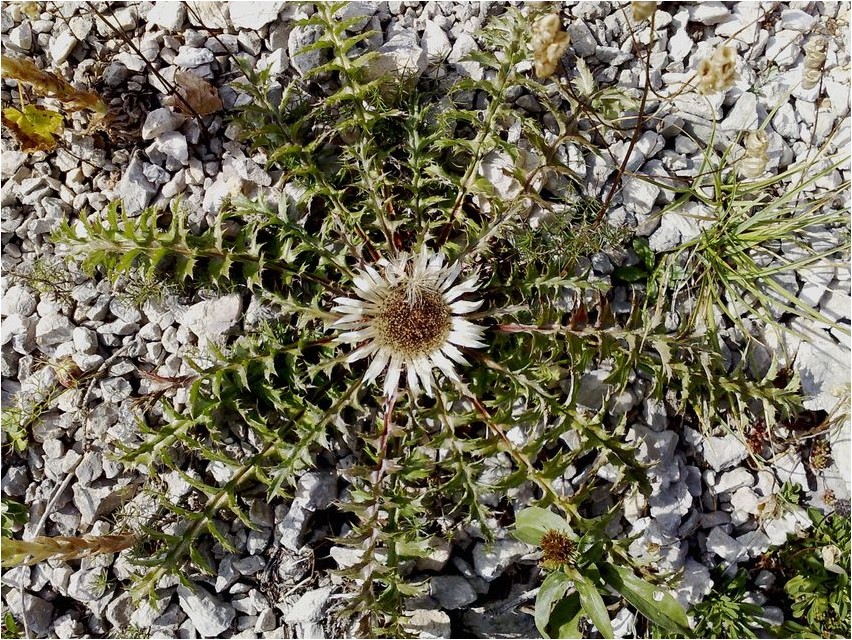
The common thorn is one of the plants of the family called Asteraceae or Asteraceae; in Latin the name of this plant will be as follows: Carlina vulgaris L.
As for the name of the common thorn family itself, in Latin it will be like this: Asteraceae Dumort.
Description of the common thornweed
Common thorngrass is also known by the following popular names: tributary grass, urochnik, white elecampane, thistle, thistle, grandfather grass, lump grass, kalyuka, tumbleweed, field bug, and slope. The common thorn is a biennial herbaceous plant, the height of which will fluctuate between twenty and one hundred and twenty-five centimeters. Such a plant will be endowed with a spindle-shaped branched root and an erect cobwebby-pubescent stem. In the first year, a rosette of linear-lanceolate and spiny-toothed leaves is formed, the length of which will be about ten centimeters. The development of the stems of this plant occurs in the second year. The flowers of the common thornweed are bisexual and tubular, the inflorescences are hemispherical baskets, of which there will be about two to four pieces. Such inflorescences are collected in a shield and each of them is equipped with a wrapper. The outer leaves of such an involucre will be leafy, while the middle ones are comb-spiny, brownish and they will be endowed with branched spines. The inner leaflets are horizontally pubescent and linear and will exceed the head. In the middle, the leaves of this plant are straw-yellow in color and ciliated. The receptacle of the common thorn will be flat and it will be covered with spiny-pointed bristles, which are fused at the very base by means of tufts. The fruit of this plant is an oblong achene, which will be hairy and they are endowed with a tuft of straight hairs.
The flowering of the common thorn occurs in the period from July to September.
Description of the medicinal properties of common thorn
Common thorn is endowed with very valuable healing properties, and it is recommended to use the fruits and herbs of this plant for medicinal purposes. The concept of grass includes inflorescences, stems and leaves.

The presence of such valuable healing properties should be explained by the content of tannins, polyacetylene compounds and alkaloids in the plant. The following flavonoids are present in the leaves of the common thorn: carlinoside, chaftoside, rutin, orientin and homoorientin.
Infusion and decoction prepared from the herb of this plant are recommended for use as a diaphoretic and diuretic, as well as for hypofunction of the stomach and externally for rheumatism. It should be noted that it was experimentally established that the extract and infusion prepared on the basis of the fruits and inflorescences of the common thornweed are endowed with a very valuable sedative effect.
It is noteworthy that the plant is not endowed with noticeable toxicity and most often does not cause any side effects. But with large doses, some excitement of the nervous system most often occurs. However, after stopping taking such drugs based on this plant, this phenomenon completely disappears.
As for traditional medicine, a decoction prepared from the common thorn herb has become quite widespread. It is recommended to give this decoction to children when they are frightened, or in this case it is permissible to burn the plant, fumigating the children with smoke. These products are very effective when used correctly.