Common medlar
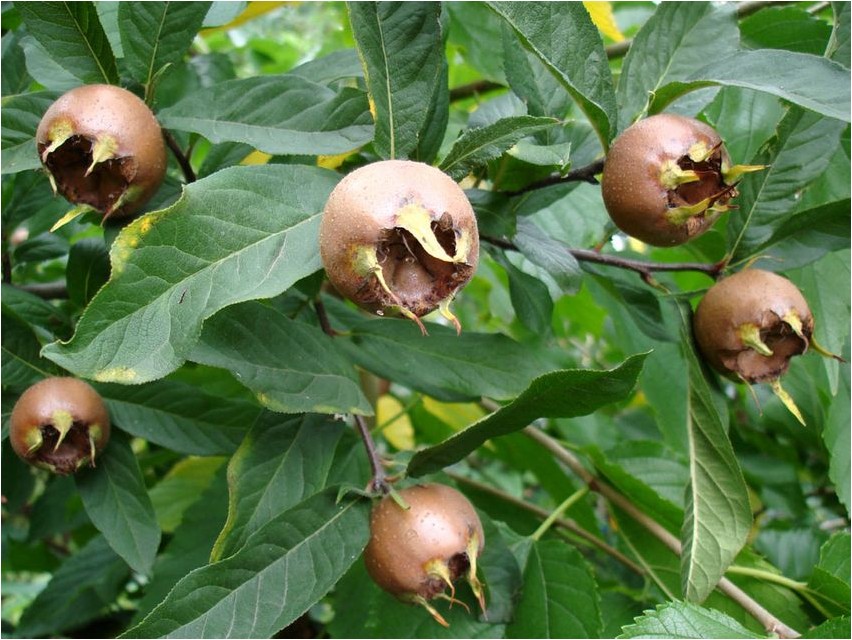
The loquat is one of the plants of the family called Rosaceae; in Latin the name of this plant will be as follows: Mespilus germanica L.
As for the name of the medlar family itself, in Latin it will be like this: Rosaceae Juss.
Description of the medlar
The common medlar is known by its popular names: shishkovnik and shishki. The common medlar is a multi-stemmed shrub whose height will vary between four and six meters. Large branches of such a plant will be covered with bark colored in grayish-brown tones, while small branches will be reddish-brown in color. Young shoots of the medlar are colored greenish and have thick felt pubescence. There will be a small number of fairly short spines on the branches. The leaves of the loquat are elliptical and entire, and they will be hairy underneath. The flowers of this plant are white, they will be large and fragrant, and also single: such flowers are located at the very top of rather short shoots. The fruits of this plant are fleshy and mild, their shape can be different, from spherical to round or pear-shaped. At first, the color of such fruits will be dirty green, and when ripe they will become reddish or brownish with a yellowish tint.
The flowering of the medlar occurs in April, while the fruits ripen in October. Under natural conditions, this plant is found in the Crimea, Iran, Asia Minor, the Balkans, the Caucasus and Turkmenistan.
Description of the medicinal properties of loquat
The loquat is endowed with very valuable healing properties, and it is recommended to use the leaves and fruits of this plant for medicinal purposes. The leaves of the common medlar should be harvested from May to August, while the fruits should be harvested in the autumn.
The presence of such valuable healing properties should be explained by the content of tannins, sugar, aromatic substances, mucus, pictin, malic and citric acid, as well as phytoncides and other useful substances in the fresh fruits of this plant. The leaves of the common medlar contain quite a significant amount of tannins.

As for traditional medicine, this plant is quite widespread here. Here, the leaves and fruits of the loquat, as well as the seeds, are used in the form of decoctions for various inflammatory gastrointestinal diseases, especially bloody diarrhea. It is recommended to gargle with a decoction or water infusion prepared from the leaves of this plant for sore throats.
From the pulp of the fruits of this plant, jam, marmalade, marshmallows, filling for sweets and compotes are prepared. Based on the leaves and roots of the medlar, it is possible to obtain brown and yellow paint intended for fabrics.
As an antidiarrheal and hemostatic agent, it is recommended to use the following remedy based on this plant: to prepare such a remedy, you will need to take one tablespoon of medlar leaves per glass of water. The resulting mixture should be boiled for five to six minutes over low heat, after which this mixture is left to infuse for one hour. In addition, this product can also be used for rinsing with sore throat. To ensure the greatest effectiveness when taking a medicinal product based on medlar, it is important to follow all the rules for preparing such a product.





