Kumquat
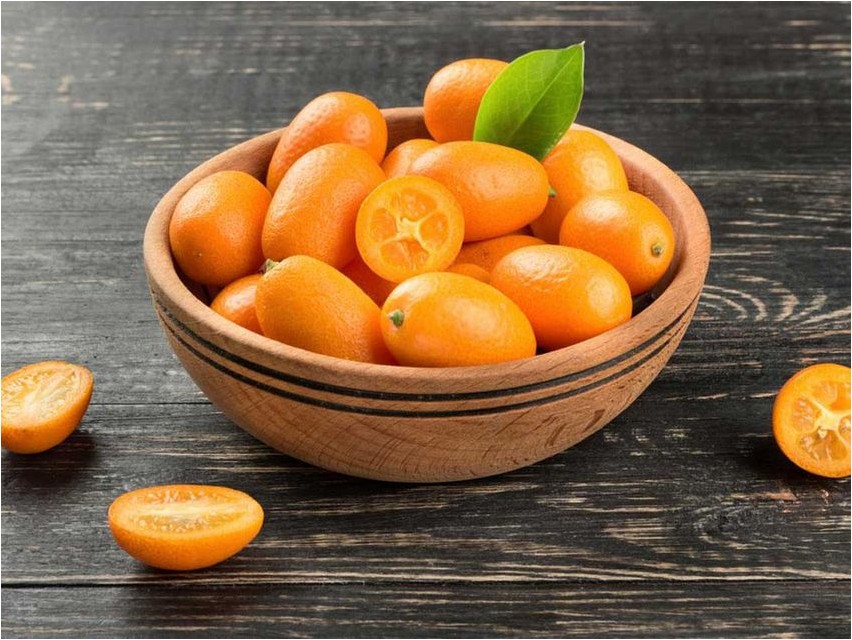
Kumquat (lat. Fortunella) is an evergreen plant from the Rutaceae family.
History
The very first literary mentions of this peculiar fruit date back to the 12th century — the kumquat was first described in China. And it came to Europe thanks to the inquisitive Robert Fortune, an English botanist, who brought these bizarre fruits to the annual London Horticultural Exhibition in 1846.
At first, the kumquat was classified as a member of the Citrus genus, but a little later, in 1915, it was allocated to the separate subgenus Fortunella.
Description
Kumquat is a plant endowed with smooth, triangular, flattened shoots, which are sometimes covered with thorns. Kumquat leaves reach a length of about 4 — 6 cm, and their width usually ranges from one and a half to two centimeters. White axillary flowers are collected in groups of two or three in miniature inflorescences, although sometimes single flowers are also found.
The diameter of the round golden-yellow kumquat fruits is 2 — 2. 5 cm. They have an external resemblance to miniature oval oranges, and their taste is reminiscent of slightly sour tangerines. By the way, kumquat is completely edible — its sweet peels can also be eaten.
There are many varieties of kumquat. The most famous are the following: Malay, Hong Kong, Fukushi, as well as Nagami, Meiwa and Marumi.

Where does it grow
Kumquat grows mainly in southern China. Currently, several varieties of this crop can be found in nature — as a rule, they differ in the shape of the fruit.
In addition to China, these attractive citrus fruits are cultivated in the southern United States (mostly Florida), southern Europe (most often on the Greek island of Corfu), the Middle East, as well as Japan and Southeast Asia.
Usage
Kumquat can be consumed not only raw — it is no less good in processed form. These wonderful fruits make excellent liqueurs, marmalades, jams and candied fruits.
It is noteworthy that kumquat is considered a dietary product — it promotes the breakdown of bad cholesterol and its rapid elimination from the body, as well as the gradual cleansing of the body of heavy metals, radionuclides and toxins accumulated in it. With the systematic consumption of these fruits, blood vessels are cleared of fatty plaques; in addition, kumquat is an excellent prevention of atherosclerosis, as well as heart attack and stroke.
In oriental medicine, dried kumquat peels are widely used to treat coughs, runny nose, flu and any colds. For this purpose, the brewed crusts are used for inhalations (such inhalations are done two to three times a day).
Natural enzymes, pectin and fiber contained in kumquat fruits help normalize the functioning of the gastrointestinal tract and are an excellent prevention of ulcers and gastritis. In addition, kumquat has an extremely beneficial effect on the nervous system — people who consume these fruits are much less susceptible to chronic stress, constant nervousness, sudden irritability and depression.
This crop is also often grown as a houseplant.
Calorie content
Despite the fact that kumquat is not high in calories (100 g of fruit contains only 71 kcal), it should not be abused — due to its high carbohydrate content, it can easily lead to obesity. This is especially true for dried kumquat (100 g of dry fruit contains 284 kcal).
Growing
Since kumquat seedlings have an extremely weak root system, it is very rarely grown from seeds. In Japan and China, in order to propagate this crop, it is grafted onto the three-leaved poncyrus.