Cherry Laurel
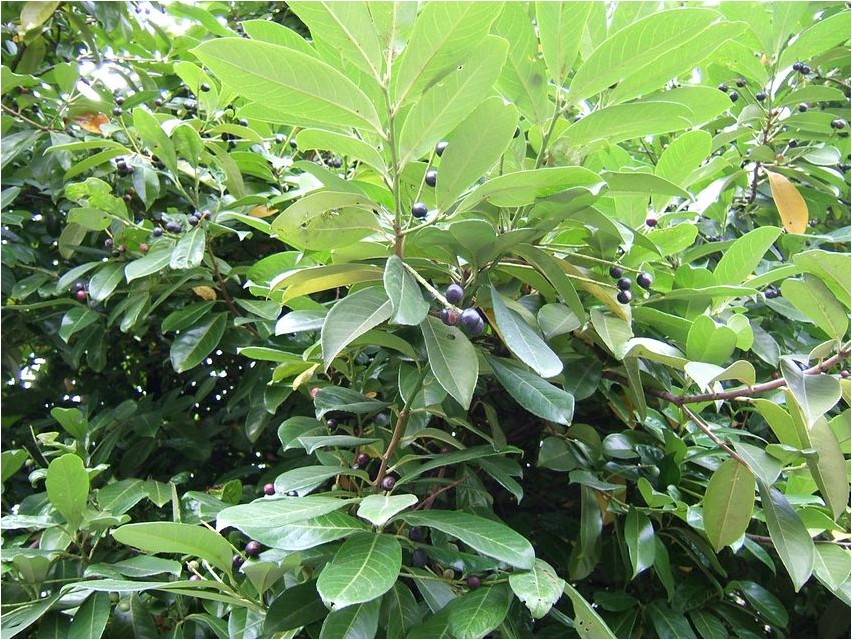
Cherry laurel (Prunus laurocerasus) is a berry crop; an evergreen plant of the subgenus Prunus of the genus Prunus in the Rosaceae family.
The plant is not a hybrid of cherry and laurel, as many gardeners believe. It received its name only because its leaves are similar in appearance to laurel leaves, and its fruits resemble cherries. Cherry laurel grows naturally in temperate regions of Eurasia and North America. It is also found in Crimea and on the Black Sea coast of the Caucasus. The fruits are edible, but the remaining parts are poisonous, containing amygdalin (mandelic acid nitrile gencibioside).
Crop Characteristics
Cherry laurel is a slow-growing shrub or tree up to 6 m tall. The leaves are large, leathery, green, ovoid, and glossy on the upper side. The flowers are creamy or white, fragrant, and gathered in racemes up to 10-12 cm long. Cherry laurel blooms in April-May (depending on climate).
The fruits are black or purple, round, and similar in texture to cherries but similar in appearance to sour cherries. The fruits have a pleasant, sweet taste and aroma; the fruits of wild varieties are slightly bitter and astringent. The most common representative of this species is the common cherry laurel (Laurocerasus officinalis M. Roem), which is distinguished by its winter hardiness, shade tolerance, and rapid growth (unlike its relatives). In winter, cherry laurel can withstand temperatures down t o-25°C.
Growing Conditions
Cherry laurel can be grown both outdoors and in containers indoors. The plant thrives in calcareous, humus-carbonate, sandy loam, and loamy soils. Cherry laurel is very demanding in terms of soil moisture. However, it is neutral in terms of light, as it can grow without problems in both sunny and shaded areas. However, it does not tolerate direct sunlight.
When growing cherry laurel indoors, place the pots near west- or east-facing windows. In summer, it is recommended to move container-grown cherry laurels outdoors. The optimal growing temperature is 20-22°C. A universal potting soil for Saintpaulias or Begonias can be used as a soil mixture. Good drainage is essential in this case.

Propagation
Cherry laurel is propagated by seeds, layering, cuttings and grafting. Seeds are sown in the fall in open ground under cover or in the spring using seedlings. The first method is the most effective. The seeds lose their viability quite quickly – this is another reason why it is preferable to plant cherry laurel in the fall. The seeds do not require pre-sowing treatment; this greatly simplifies the work of gardeners. In case of autumn sowing, seedlings appear with the onset of warmth and snow melting, in case of spring seedlings – on 8-17 days.
It is recommended to sow cherry laurel in moist soil, this way you can speed up the emergence of seedlings. In the phase of 2-3 true leaves, the seedlings are transplanted into the ground and immediately to a permanent place; this should not be done at a later date, since the root system of the plants does not tolerate transplantation well. Vegetative methods of propagation do not cause any particular difficulties. Cuttings and laying layering in the ground are carried out in the spring.
Care Watering is regular and plentiful throughout the entire gardening season; it is not recommended to allow waterlogging. Otherwise, brownish spots will appear on the cherry laurel leaves and, as a result, they will begin to lose turgor and fall off, which is simply unacceptable. Laurel cherries grown indoors are watered year-round as the top layer dries. In hot weather, spraying is also necessary, but they are carried out only in the evening or early morning before the sun appears.
Fertilizers for cherry laurel play an equally important role. Plants grown in open ground are fed three times per season; indoor specimens – once a month with liquid complex mineral fertilizers. The growth of shrubs is limited by formative pruning, which is combined with sanitary pruning. The crop is not prone to pests and diseases; rare uninvited guests are scale insects and scale insects, but with constant care their invasion can be avoided.
Application
The fruits of cherry laurel are used in cooking to make jams, preserves, jellies and wines, and the leaves are used in folk medicine to obtain various tinctures and oils that are useful for cardiovascular diseases, insomnia and depression. The culture is widely used in garden design. It is ideal for creating a hedge, suitable for making groups of tall evergreen shrubs and trees.





