Cream apple
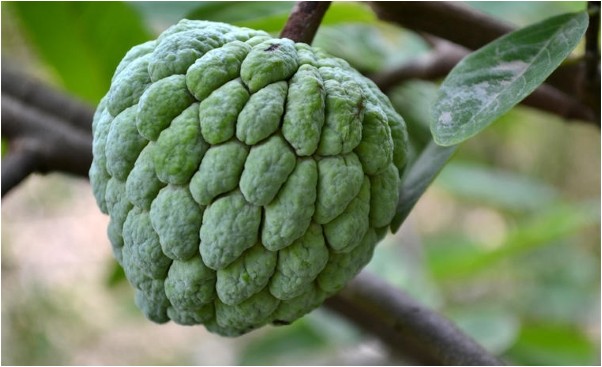
Cream apple (lat. Annona reticulata) is a fruit crop belonging to the Annonaceae family. Sometimes she is also called Annona reticularis.
Description
The cream apple is a small tree, extremely rarely reaching ten meters in height and endowed with dark green oblong-lanceolate leaves, the length of which ranges from ten to twenty centimeters and the width from two to five centimeters. If you pick such a leaf and rub it thoroughly, it will begin to exude a very pleasant and delicate aroma.
The flowers of the cream apple are quite large (their diameter reaches four and a half centimeters) and also smell very pleasant. The corollas of these flowers are formed by two layers of fleshy petals, which are colored pale yellow on the inside and greenish-yellow on the outside. The main feature of these flowers is that under no circumstances do they open completely. Moreover, they appear not only on branches, but also on tree trunks!
The complex fruits of the cream apple are characterized by a heart-shaped shape and reach a diameter of eight to sixteen centimeters. Their thick skin can be either yellow or brown, with a slight reddish-brownish, reddish or pinkish blush and a distinct, intricate mesh pattern. The pulp of these fruits is characterized by a fibrous-cream structure, and in the middle of it are shiny black or black-brown seeds, unsuitable for consumption.
Trees begin to bear fruit approximately in the third or fourth year, and each adult tree is capable of producing from fifty to a hundred fruits throughout the year. And they usually ripen in July.
Where does it grow
The cream apple came to us from the distant Antilles, but back in ancient times, almost at the dawn of civilization, people successfully introduced it into Southern Mexico and Central America, and a little later it reached Brazil and Peru. And closer to the seventeenth century, bizarre trees came to Africa, after which they quickly spread throughout the “dark” continent. It is worth noting that cream apple is now cultivated in small quantities in India, as well as in a number of countries in Southeast Asia (these include the Philippines, as well as Guam, Vietnam, etc.). Nowadays, people know several different varieties of this crop.

Application
These fruits are eaten not only fresh — they are often ground and added to the filling for custard pies (due to this, these fruits are often called custard apples). There are a great many recipes for other cream apple dishes, but these are mainly desserts.
These fruits are endowed with the ability to speed up metabolism and improve digestion, and their rich fiber content makes them excellent helpers for constipation and a number of other intestinal problems, including dysbiosis. And the hunters of Amazonian Silva simply adore the custard apple for its ability to improve vision. In addition, these fruits contain antioxidants that reliably protect the retina from destruction by free radicals, and also help prevent clouding of the lens and slow down the aging process of eye tissue.
Contraindications
Latin American scientists were able to establish that excessive consumption of custard apple can increase the risk of Parkinson”s disease. The conclusion is, of course, very controversial, but in any case, everything is good in moderation.
But cream apple seeds are very poisonous and can lead to serious poisoning, so you should never eat them! If the juice from these seeds accidentally gets into the eyes, it can cause very serious visual impairment, including complete blindness.
Pregnant or lactating women should not consume these fruits.