Lanceolate Lily
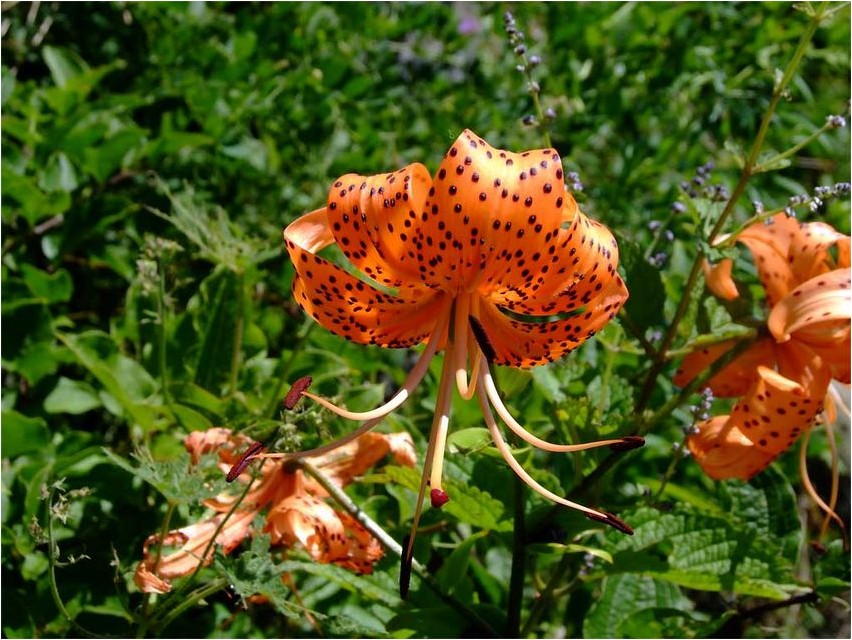
The lanceolate lily is a member of the lily family. Its Latin name is Lilium lancifolium Thunb. (Lilium tigrinum Ker-Gawl.).
The family name of the lanceolate lily itself is Liliaceae Juss.
Description of the lanceolate lily
The lanceolate lily is a herbaceous bulbous plant, reaching heights between fifty and one hundred and thirty centimeters. Its rhizome is creeping, with small bulblets, and its stem is densely covered with white, cobwebby hairs. Its leaves are lanceolate and entire, bearing small bulblets located in the axils. The flowers of this plant are quite large, orange-red in color with dark brown spots. The fruit of the lanceolate lily is a capsule. This plant blooms from July to September.
In the wild, this plant is found in the Primorsky Krai. It prefers gardens, parks, meadows, and river valleys.
Description of the medicinal properties of the lanceolate lily
The lanceolate lily is endowed with very valuable medicinal properties. It should be noted that the chemical composition of this plant has not yet been fully studied. However, it is known that the bulb and aerial parts of this plant contain saponins and alkaloids.
For medicinal purposes, it is recommended to use the flowers and bulb of this plant. The bulb has hemostatic, analgesic, diuretic, wound-healing, laxative, tonic, and expectorant properties. Furthermore, these remedies have the ability to regulate menstruation.

Lili lanceolata bulbs are also widely used in Chinese medicine. These elements of this plant are used as a tonic, diuretic, antitussive, laxative, and a dietary tonic. Furthermore, these bulbs are used for menstrual irregularities and various gynecological conditions. A tincture prepared from the flowers of this plant is recommended for homeopathy for uterine prolapse, cervical erosion, and various other gynecological ailments.
Traditional medicine uses the bulb of this plant boiled in milk as an external remedy for abscesses and furunculosis. The lightly boiled onion of this plant is also used as a uterine analgesic and diuretic. To prepare such a remedy, it is recommended to take a fifteen gram bulb of lanceolate lily and scald it with boiling water. The resulting healing mixture should be infused for about ten to fifteen minutes, and then this mixture is filtered. This very effective remedy based on this plant should be taken about three to four times a day, one tablespoon at a time.
In addition, it should be noted that the lanceolate lily bulbs themselves are also edible. These onions can be eaten boiled or baked. At the same time, sometimes the bulbs of this plant are dried, then ground: after which either bread is baked or porridge is cooked from such flour. Due to the fact that the chemical composition of this plant has not been fully studied, new ways of using lanceolate lily may appear in the near future.





