Angophora
Angophora (Latin: Angophora) is a genus of flowering plants in the myrtle family (Latin: Myrtaceae). The genus”s sixteen species include shrubs and trees. They are endemic to distant Australia, but are also cultivated elsewhere on the planet.
What”s in a name
The Latin genus name “Angophora” is derived from two Greek words: “angos” and “phora,” which in Russian translate as “vessel or box” and “carries.” The genus owes its name to the appearance of the fruits of the genus”s plants.
The plant community, currently consisting of sixteen species, was first described as a genus in 1797. Botanists have long debated the delineation of the three genera of plants in the Myrtaceae family: Angophora, Corymbia, and Eucalyptus. These trees are so similar that they are often referred to collectively by the common name “Eucalyptus.” Collectively, the Eucalyptus family, also known as “gum trees,” dominates many Australian ecosystems. Some botanists claim that Angophora is a distinct genus, while others continue to debate the issue.
European settlers of Australia nicknamed Angophora trees “apple trees” because of their resemblance to apple trees. This name is still commonly heard today.
Description
Members of the Angophora genus have chosen Australia as their habitat, where they grow as dense shrubs or as trees rising to heights of up to thirty meters. Most plants have rough, ridged bark.
The dark green leaves of Angophora, with clearly visible cross-veins, are arranged oppositely on the stems, unlike the alternate leaves of Eucalyptus. The leaf blade is entire, lanceolate, with a pointed, rounded tip. Young leaves are hairy and glandular, but later lose their hair.

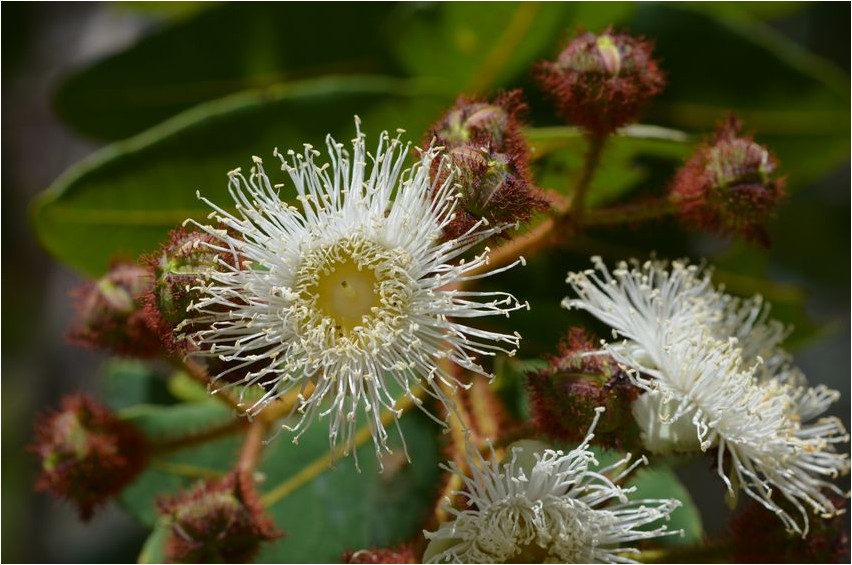
The large inflorescences of Angophora consist of small, independent clusters of three to seven flowers, which differ from those of Eucalyptus in the absence of a wing-like shell-like structure that falls off when the flowers open. At the base of the flowers are four or five miniature green sepals. The sepals are overlain by creamy-white petals and whorls of numerous stamens.
The fruit of Angophora, which completes the plant”s growing cycle, is a papery or slightly woody capsule, usually with thick sharp ribs, covered with woolly hairs.
Varieties
As an example, consider several of the sixteen species of the Angophora genus:
* Ribbed Angophora (lat. Angophora costata) is a tree up to thirty meters high with smooth, scaly bark. Prefers sandy soils.
* Angophora crassifolia (lat. Angophora crassifolia) is a small tree up to fifteen meters high with thick and hard leaves.
* Almost velvety angophora (lat. Angophora subvelutina) is a tree with a height of twelve to twenty meters, but in very favorable conditions it can grow up to thirty-five meters. Where it grows, the soil is fertile and suitable for agriculture. The leaves are similar in shape to eucalyptus, but are located opposite on the stem.
* Angophora melanoxylon (lat. Angophora melanoxylon) is rather a tall shrub with several stems up to fifteen meters high. Gray or grey-brown bark covers the main stems. The leaves are gray-green to green.
* Smooth-barked angophora (lat. Angophora leiocarpa) is a tree up to twenty-five meters high with gray-cream smooth bark, which is visible here and there with small pink spots.
Explanation of the Liturgy. The most important part of the service is ANAFORA