St. John’s Wort
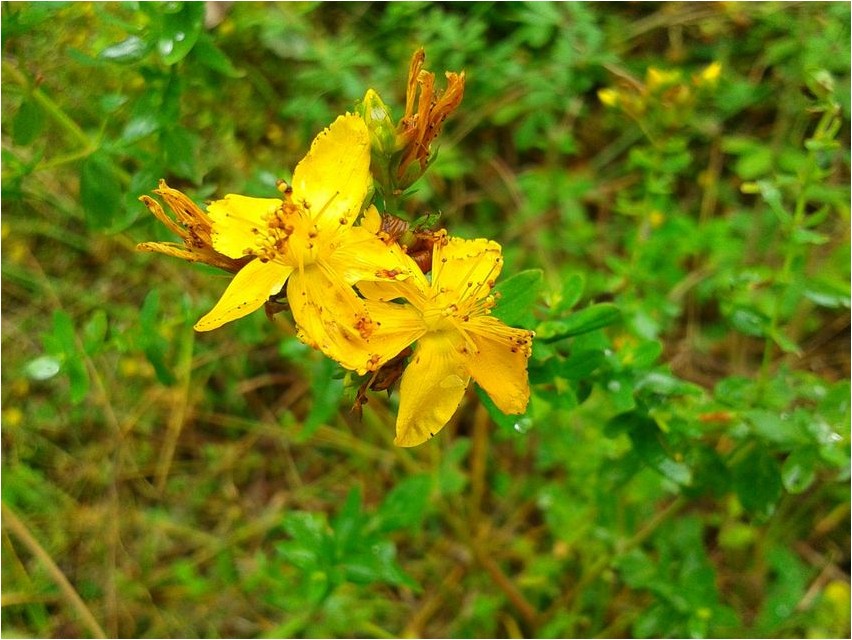
St. John’s Wort is a member of the St. John’s Wort family. Its Latin name is Hypericum attenuatum Choisy.
The family name itself is Hypericaceae Juss.
Description of St. John’s Wort
St. John’s Wort is a perennial herb, growing between ten and seventy centimeters tall. Its stems are numerous, rounded and straight, and have two more or less noticeable ribs. These stems also bear sparse glandular markings in the form of black dashes or dots. The leaves are opposite and sessile, and can be oval, broadly oval, or oblong-oval. These leaves are endowed with numerous small, inconspicuous, translucent black glands located along the margins and on the surface. St. John’s wort flowers are few in number, borne in a sparse paniculate inflorescence that is almost corymbose in shape. The petals of this plant are pale yellow, oblong and obovate. The fruit of St. John’s wort is an ovoid or ovate-oblong capsule, conical in shape. The seeds are quite small, finely cellular, oblong, and light yellow.
St. John’s wort blooms from June to September. In the wild, this plant is found in the Far East (Primorye, Amur Region, and Sakhalin), as well as in the Lena-Kolyma and Angara-Sayan regions of Eastern Siberia. Generally, it is found in China, Japan, Mongolia, Manchuria, and the Korean Peninsula. It prefers forests, coastal gravel beds, fields, and dry, steppe-like mountain slopes.
Description of the Medicinal Properties of St. John’s Wort
St. John’s Wort has valuable medicinal properties, and it is the herb that is recommended for medicinal purposes. The herb includes the leaves, flowers, and stems of this plant. These valuable medicinal properties are due to the plant’s content of tannins and the anthraquinone hypericin.
As for traditional medicine, a decoction of the herb is widely used for dizziness and headaches, as well as for hemoptysis, uterine bleeding, hematemesis, eclampsia, urolithiasis, neuralgia, mastitis, various bruises and abrasions, rheumatic pain in the joints, and also with insufficient milk in nursing mothers.

Powder from dry herbs and fresh crushed herbs of this plant are used as powders and plasters for a variety of external boils, traumatic bleeding and carbuncles.
For dizziness, headaches, eclampsia and urolithiasis, it is recommended to use the following remedy based on St. John’s wort: to prepare such a remedy, you will need to take ten grams of dry crushed herb per glass of boiling water. The resulting mixture should be boiled for four to five minutes, and then left to steep for two hours in a warm place, after which this mixture should be filtered very carefully. Take this remedy based on St. John’s wort, taken in one-fourth or one-third of a glass three times a day. To achieve the greatest effectiveness, you must follow all the rules for preparing such a product, as well as all the rules for taking this product.





