Eccremocarpus
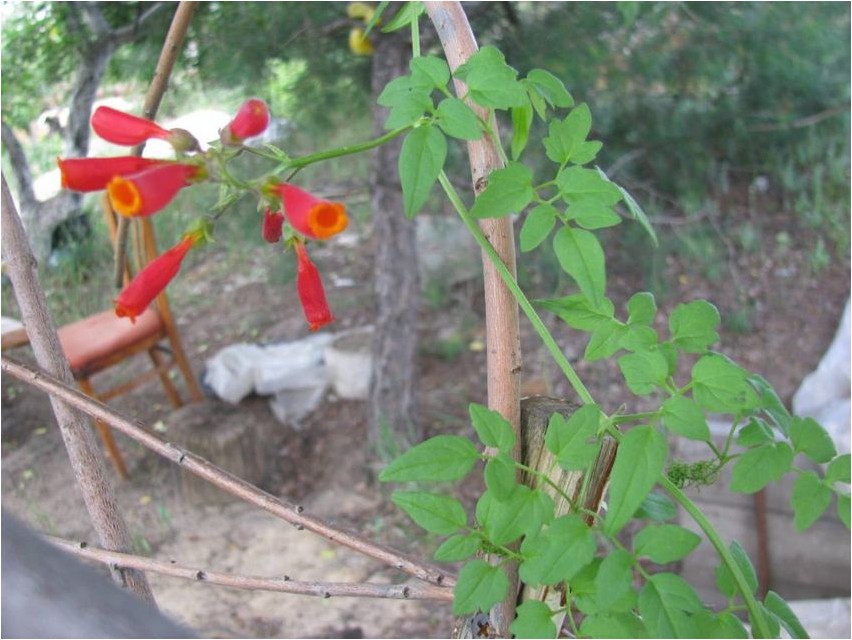
Eccremocarpus (lat. Eccremocarpus) is a genus of climbing vines and shrubs of the Bignoniaceae family. Other names are Eccremocarp or Visloporp.
The genus includes only three species; only one species is used in ornamental gardening — Eccremocarpus scaber. Under natural conditions, representatives of the genus grow in South America.
Characteristics of culture
Eccremocarpus, or Vislocarpus, is a climbing vine or clinging shrub with green, single or multi-pinnate leaves, equipped with tendrils at the tips, with which the plants cling to support. The flowers are large, bisexual, bell-shaped or tubular, can be yellow, orange or red in color, collected in sparse decorative racemes that form at the ends of the shoots. The calyx is corolla-shaped, greenish, five-toothed. The corolla is tubular in shape, has small teeth and a narrowed throat. The fruit is a capsule. The seeds are numerous and winged.
Eccremocarpus rougha is the most common species; in Europe and America it is used for landscaping park areas; in Russia it is cultivated as an annual on personal plots. The species is characterized by rapid growth; during the season the plants reach a length of 4-5 m. The leaves of Eccremocarpus rougha are shiny, lacy, and pinnate. The flowers are bright orange, carmine red or deep yellow, collected in racemes, the length of which varies from 10 to 15 cm. Flowering is long, usually from July to September — early October. Suitable for landscaping fences, house walls and other buildings. Today there are forms of ecremocarpus with pink and cherry-pink flowers.
Subtleties of cultivation
Eccremocarpus, or Vislocarpus, needs open sunny areas, protected from cold piercing winds. It is preferable to plant the crop near the southern walls. The soil for plants is desirable to be light, loose, nutritious, and moderately moist. Eccremocarpus does not accept swampy, waterlogged and highly acidic soils. It is not forbidden to grow crops in pots and other large containers on balconies and verandas. Plant support is required.
On the territory of the Russian Federation, ecremocarpus is propagated by seeds. The most effective method is the seedling method. Seeds do not need preliminary preparation. Sowing is carried out in March-April in seedling containers. After sowing, the soil is shed generously with a spray bottle and covered with plastic film, which is removed from time to time for ventilation. You can make small holes in the polyethylene for ventilation. Shoots appear in 2-3 weeks.

In the phase of 1-2 true leaves, seedlings dive into separate pots equipped with small supports. It is recommended to use peat pots so that the root system of the seedlings is not damaged during replanting. Eccremocarpus is transplanted into open ground in late May — early June. Before transplanting, the plants are hardened, periodically taking the pots out onto the balcony or street with increasing time daily. In regions with warm and mild winters, the crop can be grown as a biennial; in this case, winter sowing is carried out — in August-September in greenhouses or greenhouses with a constant air temperature of 13C.
Care
Watering should be regular and daily. Container specimens are fed weekly, while those grown in open ground are fed 3 times per season. If all conditions are met, the plants will thank you with abundant flowering and rapid growth. Eccremocarpus is rarely affected by pests and diseases, and is rarely attacked by aphids. It is easy to combat aphids: plants are sprayed with a soap solution or insecticides against leaf-eating insects.