Musk mallow
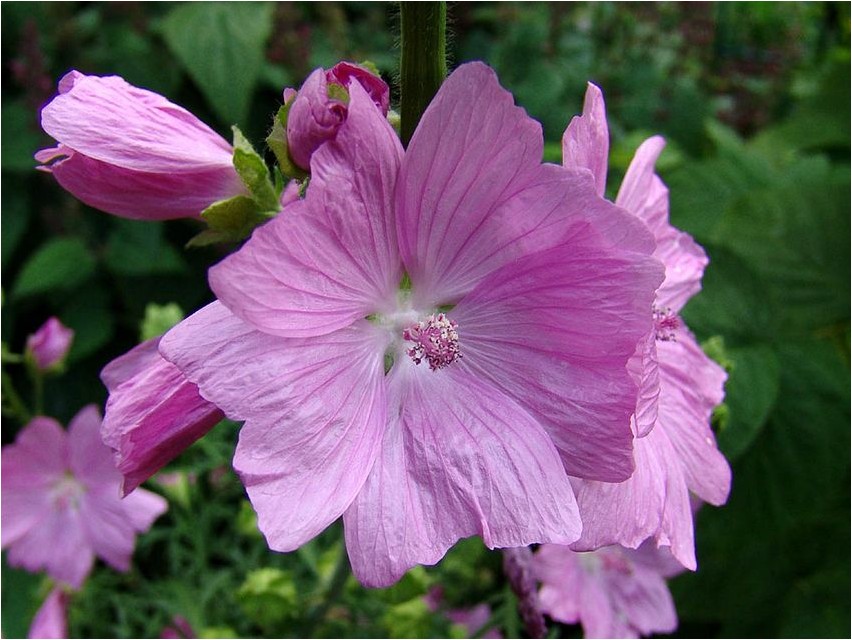
Musk mallow is one of the plants of the family called malvaceae; in Latin the name of this plant will be as follows: Malva moschata L.
As for the name of the musky mallow family itself, in Latin it will be like this: Malvaceae Juss.
Description of musky mallow
Musk mallow is a perennial herbaceous plant whose height will vary between twenty and sixty centimeters. This plant is colored in light green tones and is endowed with a very intense musky odor. The stems of musk mallow are straight, cylindrical and branched, they are covered with hairs that sit on small tubercles. The basal leaves of this plant will be long-petiolate and almost round, with the upper leaves being tripartite. On top, all the leaves of the musky mallow are bare, and on the bottom they are covered with long pressed hairs. The flowers of this plant can be single or in threes in the axils of the upper leaves or on the tops of the stems. Such flowers form a more or less multi-flowered inflorescence. The height of the musk mallow corolla will be about fifteen to twenty-five millimeters, while such a corolla will be two to two and a half times higher than the calyx itself and such a corolla will be painted in pale pink tones, and the petals will be obovate in shape. The fruits of this plant consist of approximately fifteen to eighteen laterally compressed fruitlets, they are kidney-shaped, their length is about two to two and a half millimeters, and the width will be similar. The musk mallow seed is smooth and kidney-shaped; it can be either gray or brownish in color.
This plant blooms from June to August, while the fruits ripen from August to November. Under natural conditions, musk mallow is found in Belarus, the Far East, the European part of Russia, the Dnieper region and the Carpathians in Ukraine.
Description of the medicinal properties of musk mallow
Musk mallow is endowed with very valuable healing properties, and it is recommended to use the roots, flowers and leaves of this plant for medicinal purposes. The presence of such valuable healing properties should be explained by the content of fatty oil and vitamin C in the leaves of this plant, while the seeds will contain fatty oil.
The roots of this plant serve as an excellent alternative to marshmallow, and the leaves of this plant are indicated for use in the form of poultices for various tumors. A decoction prepared from the flowers and leaves of this plant is a very effective enveloping and emollient gargle.

As for traditional medicine, here this plant is very widespread. A decoction based on the root of musk mallow is used for influenza, pneumonia, catarrh of the upper respiratory tract, bronchial asthma, bronchitis, sore throat, diarrhea, kidney disease, dyspepsia in children, jaundice, dysentery, stomach and duodenal ulcers, inflammation of the bladder and stones in it, gastritis, involuntary and difficult urination.
As for the external use of this plant, an infusion prepared from the root of the musky mallow is used for enemas for diarrhea, douching, eye washing for conjunctivitis, as well as for gargling and mouthwash for sore throat. Such healing agents turn out to be very effective when used correctly.





