Georgian Madder
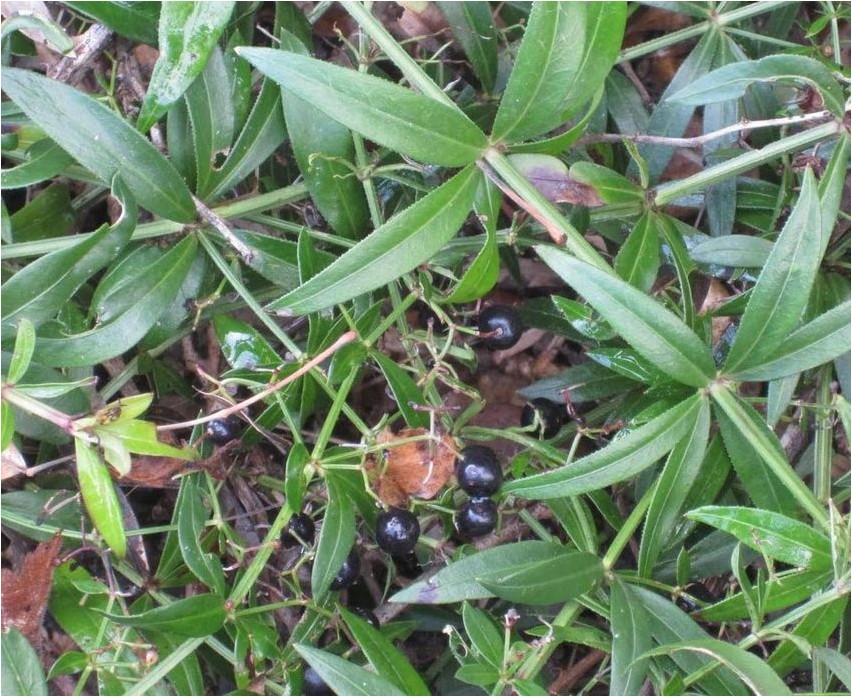
Georgian madder is a member of the bogbean family. Its Latin name is Rubia iberica (Fisch. ex DC.) C. Koch (R. tinctorum L. var iberica Fisch. ex DC.).
The family name of Georgian madder itself is Menyanthaceae Dumort.
Description of Georgian Madder
Georgian madder, or dyer’s madder, is a perennial herbaceous plant with climbing or recumbent stems, which are pubescent, especially at the nodes. These stems reach a length of approximately two meters. The taproot of this plant is very robust and branches into secondary roots. Long, woody rhizomes extend horizontally from the upper portion of the taproot, bearing nearly all regenerative roots. The stems of Georgian madder are rough, branching, and tetrahedral. The leaves of this plant are arranged in whorls of four to six, pointed and lanceolate-ovate, tapering into a distinct petiole. These leaves are spiny along the margins and pubescent beneath. The flowers of Georgian madder are arranged in spreading cymes; they are quite small, with a yellowish-greenish corolla and an underdeveloped calyx. This plant has only five stamens, and the ovary is inferior. The seeds of Georgian madder are black and wrinkled, convex on the outside and depressed on the inside.
In the wild, this plant is found in Crimea, the Caucasus, and the Lower Volga region of European Russia. Georgian madder prefers sand, rocky slopes, forests, gardens, vineyards, coastal plains, floodplain terraces, roadsides, and canal banks, from lowlands to mid-mountain zones.
Description of the medicinal properties of Georgian madder
Georgian madder has very valuable medicinal properties, and the rhizomes and roots of this plant are recommended for medicinal purposes.
The presence of such valuable medicinal properties can be attributed to the presence of purpurin, anthraquinones, alizarin, rutadine, gibericin, lucidin 3-glucoside, lucidin, pseudopurpurin, haliosin, nordamnocanthol, and ruberythric acid in the rhizomes. The aboveground parts of this plant contain the following iridoids: desacetiasperuloside and asperuloside.

As for traditional medicine, healing remedies based on this plant are quite widespread. Traditional medicine recommends using crushed roots and rhizomes mixed with alum and fat: such healing agents are used topically for pustular rashes on the face; mixed with honey for rubbing, this remedy is used as a very effective painkiller for pain in the arms after heavy physical work, rheumatism and pain in the legs after long walking. Mixed with egg yolks, this remedy is used for bruises, and as part of various preparations it is used for tumors of both the arms and legs. It is recommended to use fresh juice of this plant for rickets, jaundice and dysmenorrhea two to three times a day, one teaspoon per day.
Infusion and tea based on Georgian madder are recommended for use as a laxative and diuretic for cholelithiasis and urolithiasis. It should be noted that in the Caucasus for a long time, Georgian madder was used to obtain a dye. It is important to remember that products based on this plant are very effective when used correctly.
Madder is dyable
https://www. youtube. com/watch? v=_mIBvcMrXNY





