Phytolacca
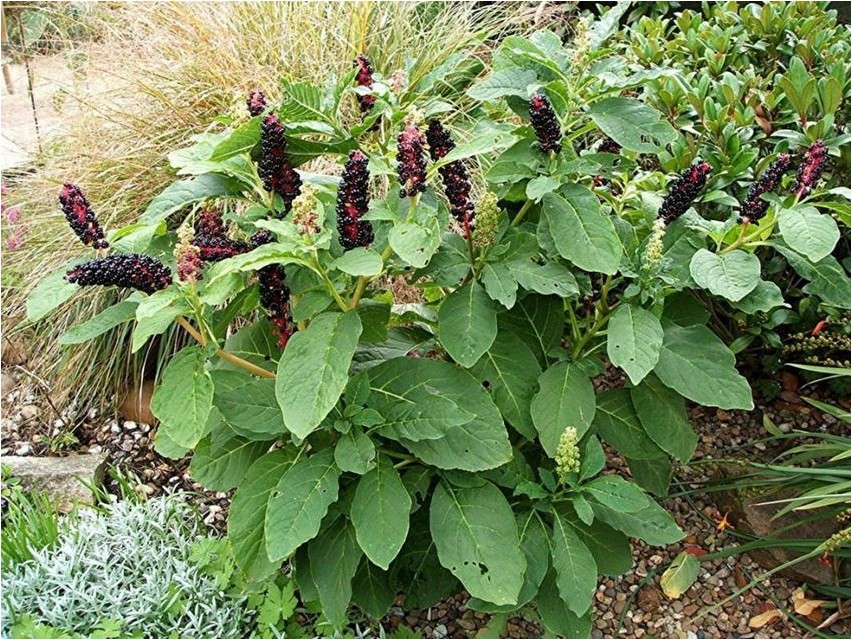
Phytolacca (lat. Phytolacca) is a light-loving, shade-tolerant perennial from the Laconaceae family. The second name is Lakonos.
In general, the name of this plant comes from the word “lacca”, which is translated from Latin as “red juice” (its black fruits actually contain bright red juice inside).
Description
Phytolacca is a herbaceous plant of quite large size and more than a meter in height. Its stems are characterized by annual dieback, and its large, opposite leaves are a rich green color and boast a pointed ovoid shape.
Bisexual white or pink phytolacca flowers form spectacular racemose elongated inflorescences located right at the tips of the shoots. And the fruits of this plant look like small berries of purple-black color. As a rule, phytolacca fruiting starts in August.
In general, the genus Phytolacca has about twenty-five species.
Where does it grow
Phytolacca is a plant native to Bermuda and the eastern United States. Most often you can meet this beauty in the subtropics or tropics. As for the territory of Russia, in its central zone only one variety of this plant is usually grown — American phytolacca. Sometimes this plant is also found in the Caucasus.

Usage
Phytolacca inflorescences last a very long time and stand great when cut, and they will look incredibly impressive in almost any arrangement. Also, this plant is planted in the background of luxurious mixed borders or in no less colorful mixed borders along with various shrubs and beautiful flowering perennials. Phytolacca is perfect for placement in single plantings, as well as as a background for almost any flower beds. It will not be rare in botanical gardens either.
Phytolacca can boast of its greatest decorative value during the period of its flowering and subsequent fruiting, that is, starting from July and approximately until October.
In no case should we forget that every single part of the American phytolacca, including its unripe berries, is very poisonous! But Phytolacca berry, or Phytolacca edible, began to be actively cultivated in Southern Europe back in the eighteenth century precisely for its juice — this juice was often used to color various wines. In addition, young green shoots of some varieties of phytolacca are eaten in a similar way to asparagus.
Growing and care
It is recommended to plant phytolacca in light shade or in the sun, but only in areas that are reliably protected from piercing cold winds. But this beauty is completely undemanding when it comes to soil; however, it will feel best on cultivated garden soils, which are characterized by a moderate moisture regime.
Phytolacca is watered quite often, since its wide leaves evaporate moisture very actively. And in the fall, as soon as the first frost hits, the phytolacca is cut off and carefully covered with humus or peat.
Phytolacca propagation usually occurs either in early spring using rhizomes or through freshly collected seeds — the latter are sown in open ground without first clearing the pulp. In this case, seed stratification is also not required. After six months of dry storage, the germination of seeds increases noticeably, and after that there is no fundamental difference in when to sow them — before winter or in spring. As for fresh seeds, they usually germinate very slowly and are extremely unimportant. Seedlings will begin to bloom only from the second year, while their first flowering is almost always delayed, as a result of which the seeds simply do not have time to ripen. And pieces of rhizomes with buds can be planted both in early spring and in autumn.