Garden quinoa
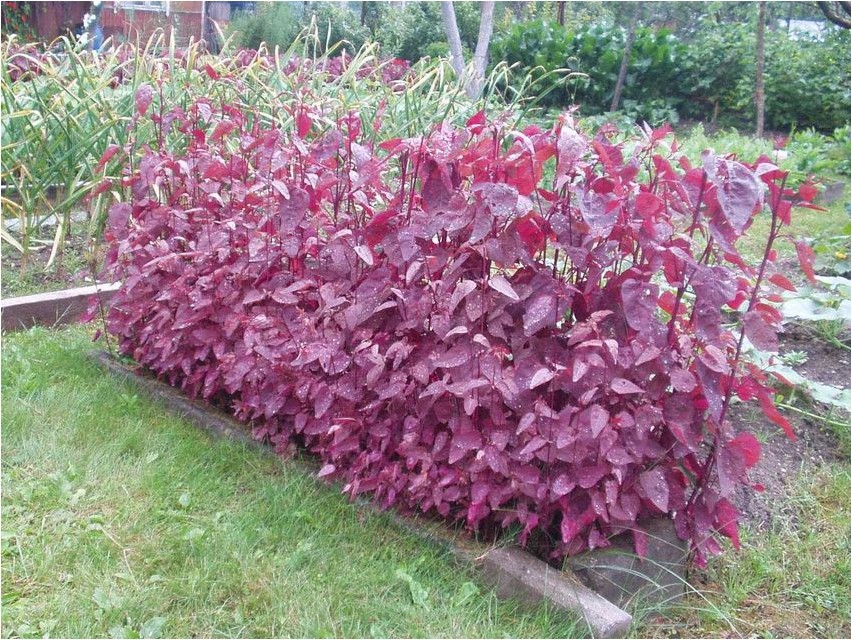
Garden quinoa is one of the plants of the family called Chenopoaceae; in Latin the name of this plant will be as follows: Atriplex hortensis L.
As for the name of the garden quinoa family itself, in Latin it will be: Chenopodiaceae Vent.
Description of garden quinoa
Garden quinoa is an annual herbaceous plant, the height of which will fluctuate between sixty and one hundred and fifty centimeters. The stem of this plant is straight and branched, the lower leaves will be quite large and triangular, they can be spear-shaped or oblong-heart-shaped, notched-toothed or entire. The upper leaves of this plant will be entire and lanceolate. Numerous flowers of garden quinoa are arranged in a long apical panicle and are unisexual; male or staminate flowers will be endowed with five stamens and a five-parted perianth. The female flowers of this plant will be pistillate without a perianth, however, they are endowed with a herbaceous spathe with the fruits. Such a spathe will consist of two bracts fused together, which in turn can be round-ovate, pointed or obtuse. The ovary of garden quinoa will be single-locular, free, and it will be endowed with one testicle and a style, which will end in two thread-like stigmas. It is noteworthy that sometimes this plant can be completely red. The fruit of quinoa is enclosed in a perianth.
Under natural conditions, garden quinoa is found in Siberia, Belarus, Ukraine, as well as in the East Transcaucasian and Pre-Caucasian regions of the Caucasus, in the Aral-Caspian, Mountain-Turkmen and Balkhash regions of Central Asia. For growth, this plant prefers steppes, slopes, salt licks, salt marshes and ravines.
Description of the medicinal properties of garden quinoa
Garden quinoa is endowed with very valuable healing properties, and it is recommended to use the seeds and herbs of this plant for medicinal purposes. The concept of grass includes the stems, flowers and leaves of this plant. The presence of such valuable healing properties should be explained by the content of phenol carbonic acids, saponins, betaine, ferulic acid, flavonoids quercetin and kaempferol in this plant. The fruits of quinoa contain vanillic and ferulic phenolcarboxylic acids, while the seeds contain blue dye, saponins and ferulic acid.
As for Central Asia, infusions and decoctions prepared from the herbs and leaves of this plant are quite widespread here. This healing agent is used as a hemostatic and diuretic agent. It should be noted that in some countries of Western Europe this plant is recommended for fresh consumption, and also in the form of decoctions, plasters, liniments, pulp with honey for malignant and benign tumors of both the larynx and other organs. It should be noted that this plant is endowed with the ability to exhibit antibacterial activity.

As for traditional medicine in both Ukraine and Russia, decoctions of the leaves and flowers of this plant are used. Such healing agents should be used for coughs that will be accompanied by a large amount of viscous and difficult to separate sputum. Externally, this plant is used in the form of emollient poultices for gouty tumors, large hemorrhoids, as well as for edematous and swollen joints. A decoction prepared from the herb quinoa is recommended for use in the form of enemas for constipation together with flaxseed oil.





