Goosefoot
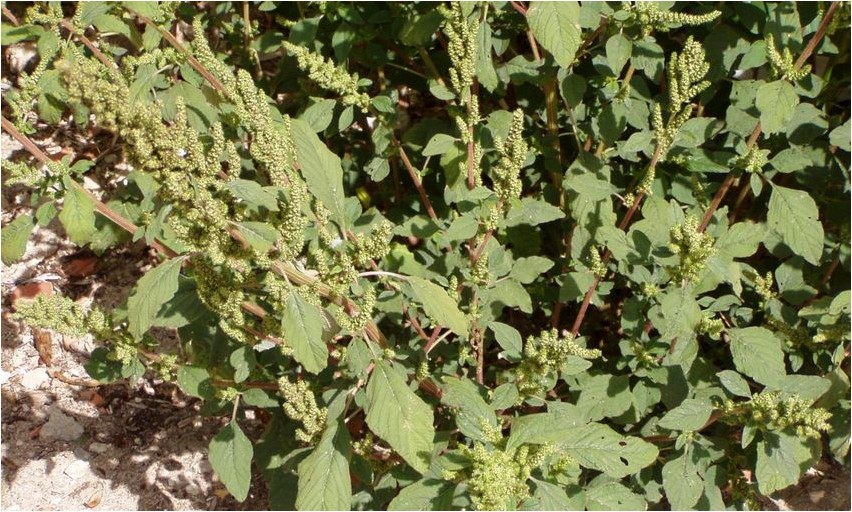
Goosefoot is a member of the Chenopodiaceae family. Its Latin name is Chenopodium ambrosioides L.
The family name of goosefoot itself is Chenopodiaceae Vent.
Description of Goosefoot
Goosefoot is an annual or perennial herbaceous plant, reaching heights between thirty and eighty centimeters. This plant has a pleasant scent and is branched, either bare or with scattered hairs at the top. Its leaves are medium-sized, oblong, or oval-elliptical in shape, with sessile glands on both the top and bottom, colored golden-yellow. These leaves are approximately six to eight centimeters long and two to three centimeters wide. These leaves are often reduced and entire on peduncles and upper branches.
The inflorescences of the Ambrosioides goosefoot are terminal, either located solely in the leaf axils or paniculate. The flowers of this plant can be either unisexual and pistillate or bisexual. The ovary of this plant is equipped with short-stalked, backward-hook-shaped glands at the top. The seeds of this plant are smooth, shiny, and blackish-brown in color, and can be either oval-rounded or rounded in shape.
In the wild, this plant is found in the Caucasus, the Black Sea and Volga-Don regions of European Russia, and in the Black Sea and Middle Dnieper regions of Ukraine. In terms of general distribution, ragweed can be found in the Balkan Peninsula, Africa, the Mediterranean countries, China, Asia Minor, Australia, and North and South America.
Description of the medicinal properties of ragweed
Garweed has very valuable medicinal properties. The roots, fruits, shoot tips, and herb of this plant are recommended for medicinal use. The herb includes the leaves, flowers, and stems.

These valuable medicinal properties are attributed to the plant’s content of triterpene saponins, flavonoids, alkaloids, vitamin C, essential oil, and the following acids: maleic, oxalic, citric, and succinic. The seeds also contain fatty oil.
It is noteworthy that in folk medicine in Latin America, powder based on the roots of this plant is quite widespread. This healing agent is recommended for the treatment of malignant tumors. As for Chinese medicine, the aerial part of the ambrosia marigold is used in various medicinal teas as a tonic, strengthening and calming agent for the nervous system. A decoction prepared from the herb or a pill from the herb powder of this plant should be used for hookworms, pinworms and worms.
Externally, a decoction based on the herb of this plant in the form of baths is used for itching and eczema. Indian medicine uses an infusion of the ragweed herb as an anthelmintic. A decoction of the herb is used for bruises and erysipelas, as well as for washing various wounds and in gynecology as an anti-trichomonas agent. The essential oil of marigold ambrosia is used as an anti-asthmatic, anthelmintic and stimulant healing agent, while the tips of the shoots of this plant are considered raw materials for the production of chenopodia oil.