Fireweed (Japanese Fireweed)
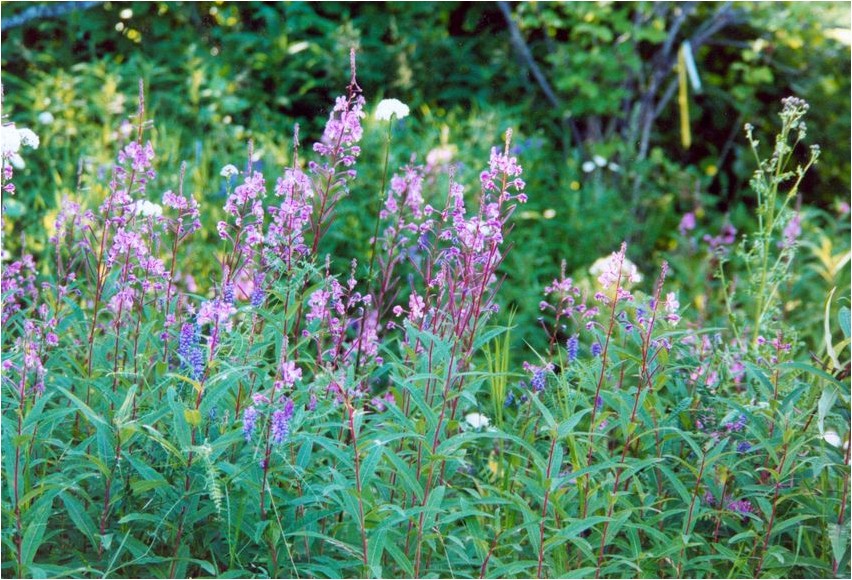
Fireweed (Japanese Fireweed) is a member of the family of plants known as the Epilobium family. Its Latin name is Epilobium japonicum.
The family name of Japanese fireweed is Onagraceae Juss.
Description of Japanese Fireweed
Japanese fireweed is a perennial herbaceous plant that grows to a height of approximately thirty to sixty centimeters. Its rhizome is quite long and has filiform sides near the root collar. This rhizome is covered with pale green, entire, rounded, and obtuse leaves. The stem of Japanese fireweed is ascending, and can be either simple or branched at the top. It is also foliated and robust. Its color can be either reddish or pale green. The lower part of the stem is bare, while the upper part is covered with curly hairs. The leaves of this plant are opposite and short-petiolate, while the upper leaves are ovate-lanceolate. Before flowering, the inflorescence of this plant is erect, and the flowers themselves are also erect, with pinkish petals. The plant itself is capitate.
Young fruit capsules are covered with curly fibers mixed with glandular ones. Older capsules are greenish in color and will be almost bare or glandular-pubescent. The seeds of this plant are pale brown, obovate-oblong in shape, rounded at the ends, and pointed at the base. Such seeds of Japanese fireweed are densely covered with papillae, and the pappus will consist of rusty hairs. Japanese fireweed blooms from August to September. In the wild, this plant grows in the Ussuri region of the Russian Far East. Its general distribution extends to Korea, Japan, and northeastern China.
It should be noted that fireweed is most widespread. This plant can reach human height in height; the plant is endowed with thin, sharp leaves and large flowers, painted in dark pink tones. Fireweed is also known as Ivan-tea: such a plant and its healing properties have been known since the times of Ancient Rus’. Such valuable healing properties are due to the presence in the plant of tannins, ascorbic acid, potassium, magnesium, calcium, iron, sodium, zinc, phosphorus, copper, manganese, as well as B vitamins.
Description of the medicinal properties of Japanese fireweed

Japanese fireweed is endowed with very valuable healing properties, and the roots, herbs and fluffy seeds of this plant should be used for medicinal purposes. The term herb includes the leaves, flowers and stems of Japanese fireweed.
A decoction prepared from the herb and roots of this plant has become quite widespread. Such remedies are recommended for use in cases of menstrual irregularities, dysentery, the appearance of blood in excrement, and also in case of too heavy menstruation. It should be noted that such a decoction of the grass and roots of Japanese fireweed can also be used as a sedative for high mobility of the fetus, which is in the womb.
It is noteworthy that the fluffy seeds of Japanese fireweed are also recommended for external use as a hemostatic agent for incised wounds. It should be noted that due to the fact that the chemical composition of this plant has not yet been fully studied, we can expect the emergence of new ways to use the healing properties of Japanese fireweed.
From Kiprey to Ivan-chai. All stages of production. Koporye tea. Business.