Thickleaf bug
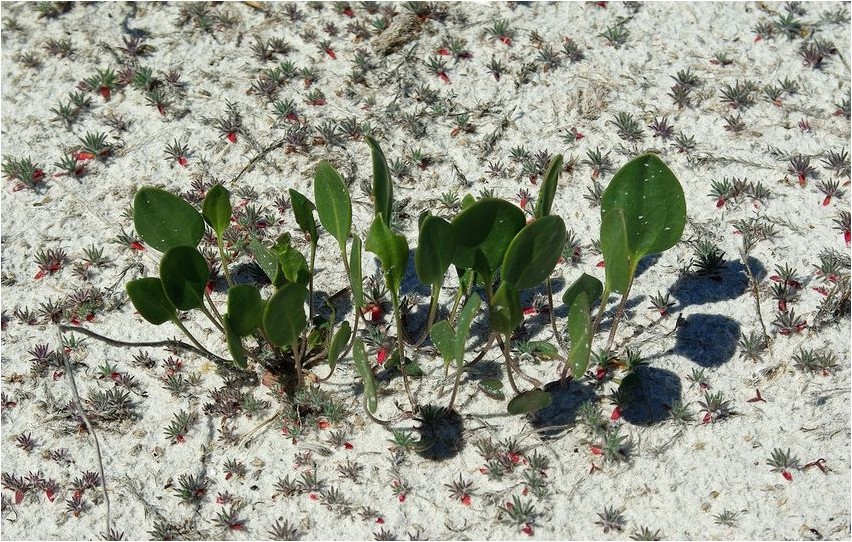
The thick-leaved bug is one of the plants of the family called cabbage or cruciferous plants; in Latin the name of this plant will be as follows: Lepidium crassifolium Waldst. et Kit.
As for the name of the bedbug family itself, in Latin it will be: Brassicaceae Burnett.
Description of the thick-leaved bug
The thick-leaved bug is a perennial herbaceous plant, the height of which will fluctuate between twenty and fifty centimeters. The stem of this plant will be bare at the bottom, but hairy at the top. The leaves of the stink bug will be thick-skinned and mostly bluish. The basal leaves of this plant will be oval and entire, the stem leaves are sessile, lanceolate and arrow-shaped. The petals of the thick-leaved bug are painted in white tones, they will be marigold and broadly obovate, their length will be one and a half to two millimeters, they will also be linear and narrow. The pod of this plant is reticulate and oval in shape, its length is three to four millimeters, and its width does not exceed three and a half millimeters. The seeds of this plant are ovoid and flattened, they will be dark red in color.
The flowering of the thick-leaved bug occurs during the period from April to May. Under natural conditions, this plant is found in Central Asia, the European part of Russia, the Caucasus, Moldova, Crimea, Ukraine, and also in the Irtysh and Verkhnetobolsk regions of Western Siberia. For growth, the plant prefers saline areas, meadows, saline lowlands, the shores of salt lakes, dry valleys and places in depressions of hilly sand, ranging from plains to the mid-mountain zone.
Description of the medicinal properties of bedbugs
The thick-leaved bug is endowed with very valuable healing properties, and it is recommended to use the seeds and grass of this plant for medicinal purposes. The concept of grass includes the leaves, flowers and stems of this plant. The presence of such valuable healing properties should be explained by the content of flavonoids in the composition of the herb.
It should be noted that this plant is endowed with antibacterial properties. As for Indian medicine, a fresh plant has become quite widespread here, which should be used externally as an irritant for rheumatism. A decoction prepared from the seeds of the bug plant is recommended for use internally for ascites and rheumatism.

For rheumatism, it is recommended to use the following very valuable remedy based on bedbugs: to prepare such a remedy, you will need to take five grams of seeds per glass of water. The resulting mixture should be boiled for three to four minutes, then this mixture is left to infuse for one hour, after which this mixture based on the bedbug plant should be filtered very carefully. Take the resulting product three times a day, one or two tablespoons. It should be noted that in order to ensure the greatest effectiveness when taking this remedy based on bedbugs, it is important to follow not only all the rules for preparing such a remedy, but also strictly follow all the rules for its administration. It is important to note that in the vast majority of cases, the use of such a remedy based on the bed bug is characterized by a very high degree of effectiveness. It is noteworthy that such a remedy can be called one of the most effective in the fight against rheumatism.





