Lupine clover
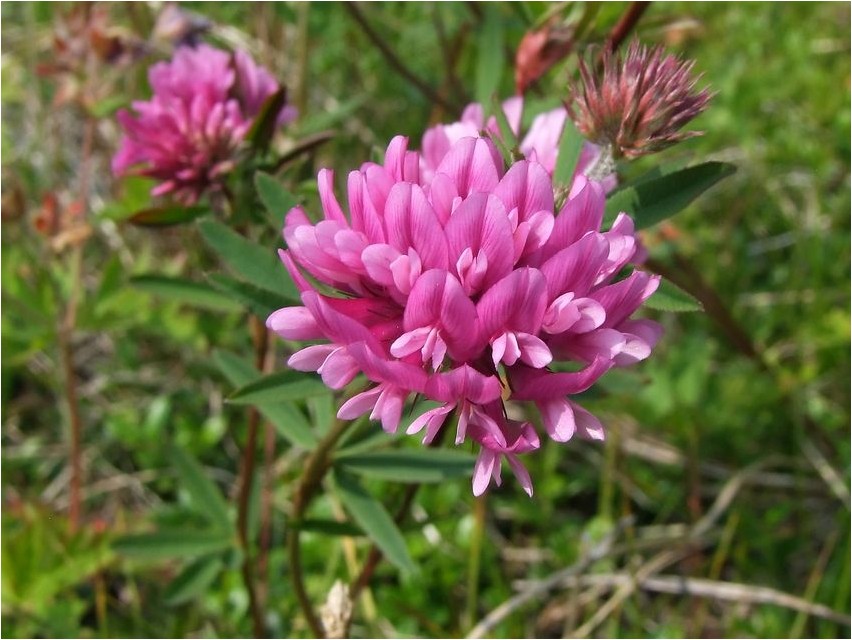
Lupine clover is a member of the legume family; in Latin the name of this plant would be Trifolium lupinaster.
As for the name of the lupine clover family itself, in Latin it will be: Fabaceae Lindl.
Description of lupine clover
Lupine clover is a perennial herbaceous plant whose height will vary between fifteen and fifty centimeters. Such a plant will be endowed with simple erect stems, which are leafless in their lower parts. The leaves of this plant will be palmate, with the lower leaves being trifoliate, the leaflets will be lanceolate, their length can reach fifty millimeters, and along the edge such lupine clover leaves will be finely toothed. The flower heads of lupine clover are one-sided and umbrella-shaped, they are located approximately one to six pieces on a common hairy peduncle. Such heads will be surrounded by a short membranous common involucre. The length of the calyx of this plant will be about eight millimeters, it will be endowed with awl-shaped teeth. The corolla of this plant is colored in lilac-purple tones; it can also be white, pink and yellow. The length of the corolla of lupine clover will be about seventeen centimeters. It should be noted that the flag will be slightly larger than the boat and wings.
Lupine clover blooms in mid-summer. Under natural conditions, this plant is found in the European part of Russia, the Arctic, Central Asia, the Far East, as well as in Western and Eastern Siberia. For growth, this plant prefers meadow steppes, light coniferous and small-leaved forests, forest edges, thickets of bushes, river meadows and lawns of mixed forests.
Description of the medicinal properties of lupine clover
Lupine clover is endowed with very valuable healing properties, and it is recommended to use the grass of this plant for medicinal purposes. The concept of grass includes the flowers, leaves and stems of this plant.
The presence of such valuable healing properties should be explained by the content of carotene, flavionoids, vitamins C and P in this plant. As for Tibetan medicine, a decoction prepared from the lupine clover herb has become quite widespread. This decoction is considered very effective when used for various diseases of the biliary tract and liver. An infusion prepared from lupine clover flowers is recommended for use for jaundice.

For cholecystitis, it is recommended to use the following remedy based on this plant: to prepare such a remedy, you will need to take about ten to twelve grams of crushed lupine clover herb per glass of water. The resulting mixture should be boiled for three to four minutes, and then left to steep for two hours, after which the mixture is filtered very carefully. Take the resulting product based on lupine clover, one third or one fourth of a glass three times a day after meals.
For jaundice, the following remedy based on lupine clover is effective: to prepare such a remedy, it is recommended to take one teaspoon of the flowers of this plant per glass of boiling water. The resulting mixture is infused for one hour and then filtered thoroughly. Take the resulting product based on lupine clover, half a glass before meals three times a day. To ensure the greatest effectiveness, it is important to strictly follow both all the rules for taking such a product and all the rules for its preparation.
Clover plant: what it is, what it looks like, properties and characteristics
https://www. youtube. com/watch? v=lpUeqQ9yaPg





