Cauliflower
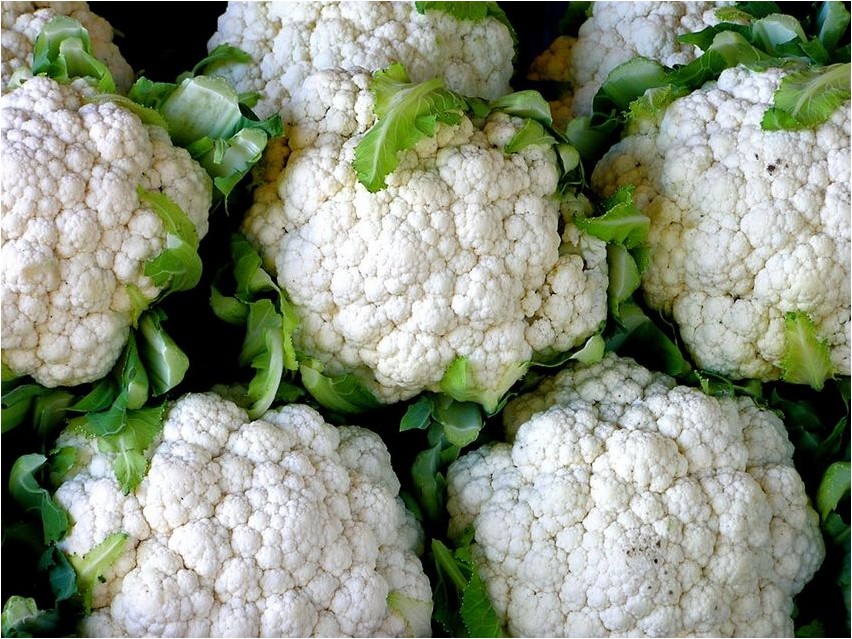
Cauliflower (lat. Brassica botrytis) is a popular vegetable crop; annual plant of the Cruciferous family.
Characteristics of culture
Cauliflower is a spring or winter plant with a fibrous root system located close to the soil surface. The stem is cylindrical, 15-70 cm high, with spirally curved leaves directed upward or straight.
The lower leaves are entire, lyre-shaped or pinnately divided, reach 5-40 cm in length, are located on petioles, can be light green or bluish with pigmentation. The upper leaves are small, broad-linear or short-oval in shape, serrated or smooth along the edge. The plates are truncated oval, narrow, elliptical or ovoid, 15-90 cm long.
The heads are flat-round or spherical, green, white, purple or yellowish in color. Flower brushes are short or long (3-15 cm). The flowers are small, rarely large, and sit on thin stalks. The petals are bubble-wrinkled or corrugated and can be white, pale yellow or yellow in color. The fruit is a multi-seeded pod, short or medium in length, usually cylindrical, sometimes tuberculate or flattened-cylindrical.
Growing conditions

Cauliflower is a demanding plant when it comes to growing conditions, though. in general, agricultural technology is similar to white cabbage. Any deviations significantly affect the crop yield and its quality. Cauliflower is light-loving and prefers well-lit areas protected from northern winds. It has a negative attitude towards thickening and shade; in such conditions it stretches out and is more often attacked by pests and affected by fungal and viral diseases.
The optimal temperature for growing the crop is 15-18C. Low and high temperatures have a detrimental effect on the formation of heads. Cauliflower grows well in moist soils with a slightly acidic or neutral pH and rich mineral composition. The plant is demanding of the presence of organic matter, macro and microelements in the soil, especially boron, copper and molybdenum. The best predecessors of cauliflower are beets, tomatoes, cucumbers, onions and legumes. It is not recommended to plant the crop after plants of the Cruciferous family (turnips, radishes, rutabaga, cabbage, etc.).
Growing seedlings and planting in open ground
Most often, cauliflower is grown through seedlings, but in the southern regions sowing seeds in open ground is common. Early varieties of cauliflower are sown for seedlings on March 5-30, mid-early varieties on April 10-May 10, late varieties on May 25-June 10. The seeds are sown in special seedling boxes filled with a soil substrate consisting of turf soil, river sand and peat in a ratio of 1:1:1. Before sowing, the soil is treated with a weak solution of potassium permanganate to prevent seedlings from being damaged by blackleg.
Immediately after sowing, the soil is watered with warm water using a spray bottle, covered with glass or film and placed in a warm room with an air temperature of 20-25C. With the emergence of cauliflower shoots, the temperature in the room is reduced to 10C, and after a week it is moved to well-lit windowsills and the temperature is maintained at 15-17C.
Seedlings are picked two weeks after emergence. A week before planting cauliflower in open ground, the seedlings are hardened off, accustoming the seedlings to wind and sunlight. Seedlings are planted in open ground in warm weather, but if the temperatures are low, it is better to postpone planting until a later date, otherwise the seedlings will sprout seeds.
The area for growing cauliflower is prepared in the fall. The soil is dug up, rotted compost, mineral fertilizers are added, and in case of high acidity, dolomite flour or lime is added. In early spring, the soil is thoroughly loosened and fertilized with wood ash. Immediately after planting, the seedlings are shaded for a couple of days. After 10-15 days, the young plants are earthed up, and a liquid infusion of mullein is added to the soil.
Care
Due to the fact that cauliflower has a special root system, it needs regular and abundant watering. With a lack of moisture, loose and tasteless heads are formed. To retain moisture for a longer period, the soil around the plants is mulched with peat. To prevent the crop from flowering ahead of time, cabbage is shaded in hot weather.
One of the most important measures for caring for cauliflower is the application of fertilizers. Three feedings are carried out during the season: the first — a couple of weeks after planting the seedlings in open ground, the second — after another 2-3 weeks with nitrophos and wood ash, the third — during the formation of the head with superphosphate, ammonium nitrate or potassium fertilizers. It is also recommended to fertilize with microfertilizers.





