Poplar
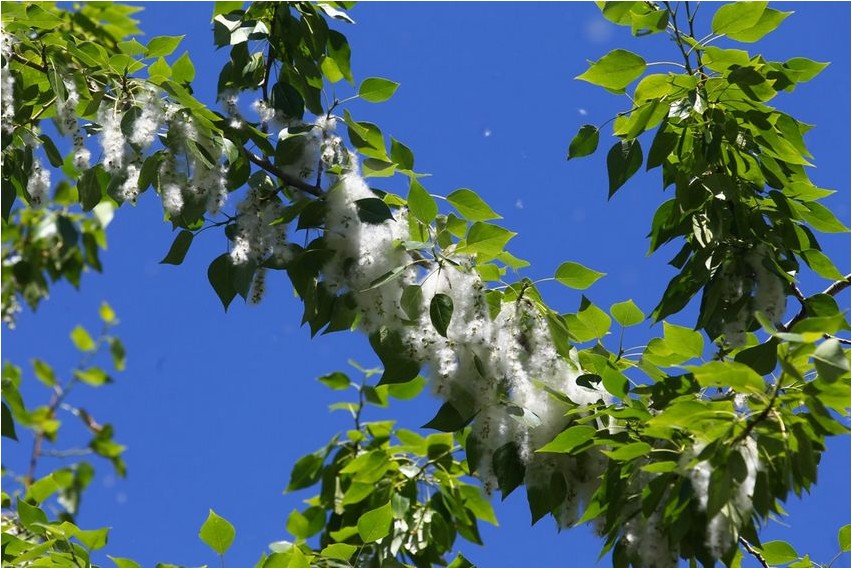
Poplar (Latin: Populus) is a genus of trees in the Salix family. Poplar is widespread in temperate regions of the Northern Hemisphere.
It is used for landscaping city parks, alleys, and roadsides. Some species are found in East Africa and South America. In the wild, it grows on well-drained slopes, river valleys, and dune sands. Representatives of the genus are characterized by rapid growth. The average age is 70-80 years.
Culture Characteristics
Poplar is a large tree up to 60 m tall with an ovoid, tent-shaped, or pyramidal crown and a trunk reaching 1-1. 5 m in diameter. The bark is dark gray or brownish-gray, fissured. The branches are covered with smooth, olive-green or gray bark. The root system is robust, with some roots located superficially. The leaves are glabrous or pubescent, broadly ovate or lanceolate, alternate, and borne on long petioles.
The flowers are small, gathered into long, pendulous or erect, cylindrical catkins, with a palmately dissected bract. The fruit is a capsule with 2-4 valves. The seeds are small, blackish-brown or black, oblong-ovate or oblong, with a tuft of numerous silky hairs (poplar fluff) at the base.
Propagation
Poplar is propagated by seed and cuttings. Seed propagation is labor-intensive and only suitable for specialists. Poplar seeds are very small and difficult to sow, as even the slightest breeze can scatter them. There are other difficulties in growing this crop using this method. To grow poplars in their gardens, gardeners use the second method, cuttings. Cuttings are taken from woody shoots in early spring (before the leaves emerge) and planted in the ground at a distance of 10-12 cm. The cuttings root very quickly (with regular watering) and produce well-developed seedlings in the first year.
Planting

Poplar seedlings are planted in early spring. Fall planting is acceptable, but not recommended. The planting hole should be at least 70-100 cm deep. The root collar should not be buried deep; it should be level with the soil surface. A ridge is formed at the bottom of the hole using a mixture of turf, sand, and peat in a ratio of 3:2:2, with the addition of mineral fertilizer. After planting, the soil around the trunk is lightly compacted and watered thoroughly. Care
Poplars are watered only during droughts at a rate of 20-25 liters per tree. Young plants are watered 2-3 times a month, as they are more sensitive to drought. The soil around the trunk is regularly loosened and weeded, and in spring and fall, the soil is dug to a depth of 10-15 cm. After 7-8 years, loosening can be stopped, and the area around the trunk can be planted with lawn or shade-friendly flower crops. Mulching is recommended; sawdust, peat, or humus can be used.
Plants tolerate pruning and trimming well and recover quickly. After heavy pruning, the plant is fed with mineral and organic fertilizers and watered generously. Poplars are frost-hardy and do not require winter cover. It is resistant to diseases and pests, but can be affected by psyllids, poplar-spruce aphids, poplar moths, and scab. At the first signs of infection, plants are treated with colloidal sulfur and organophosphorus insecticides.
https://www. youtube. com/watch? v=RcJ3LUm3RH8
Poplar