Wintergreen
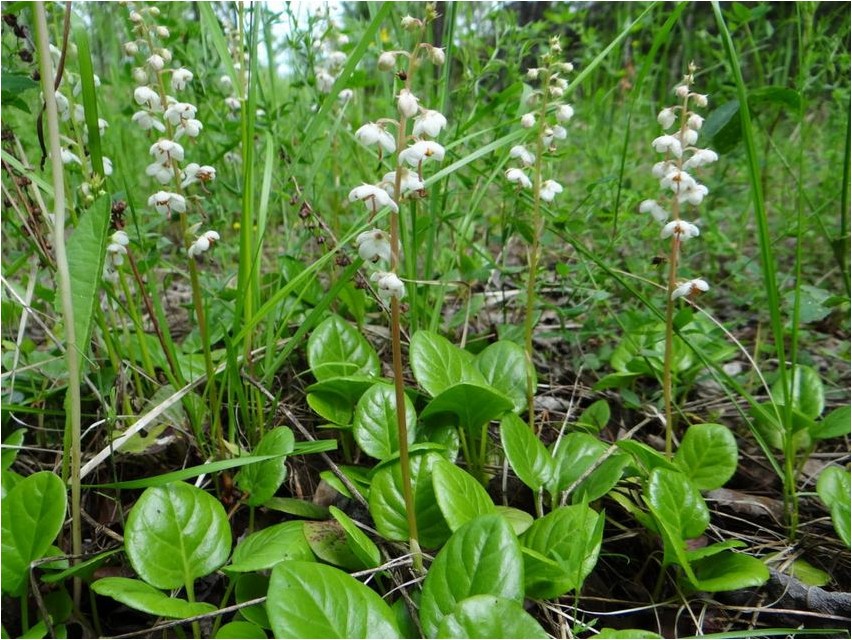
Wintergreen (lat. Pyrola) is a genus of herbaceous plants of the Ericaceae family. The genus includes 40 species. Common names are umbrella winterweed, blackleaf, live grass, may grass, wild incense, light grass or pear grass.
The genus is circumpolar boreal. Representatives of the genus are found naturally in the temperate and arctic zones of the Northern Hemisphere. Only four species grow in Russia. Typical places are coniferous and deciduous forests.
Characteristics of the culture Wintergreen is a perennial plant with a branched and long rhizome, from the nodes of which above-ground stems and adventitious roots are formed. The stem of the plant is thinly ribbed, up to 30-40 cm high. The leaves are leathery, hard, glossy, round, oval or ovoid, crenate or entire, sit on petioles, collected in a rosette.
The flowers are drooping or rejected, collected in sparse, straight racemes. The corolla is white, fragrant, five-petaled, spherical or goblet-shaped. The petals are thickened, concave, obtuse, rounded-ovate. The pedicels are long, formed from the axils of the bracts. The fruit of wintergreen is a drooping capsule.
The crop blooms in June-July, the fruits ripen in August-September, which largely depends on the climatic conditions of cultivation. Almost all representatives of the Wintergreen genus are characterized by symbiosis with fungi, and first of all this concerns the early stages of crop development, because the seeds feed mycorially during germination.
Growing conditions
Wintergreens prefer shady areas with moist, loose, sandy and slightly acidic soil. The presence of fungal hyphae in the soil is necessary, since plants are in symbiosis with fungi. Such soil can be brought to the site from places where wintergreen grows naturally. You can use fallen leaves or peat to acidify the soil. A layer of the listed natural materials is laid as mulch in the near-stem zone.

Reproduction
Wintergreen is propagated by seeds and division. The second method is not always appropriate and feasible, since the culture has a negative attitude towards dividing the root system. However, under favorable growing conditions, the divisions quickly take root.
Maintenance Maintenance is standard: watering, loosening, weeding and fertilizing. Although the last procedure is optional. Mulching immediately after watering will keep the soil moist for a longer time and free of weeds.
Application
Wintergreen is ideal for creating shady flower beds. Among the representatives, the most decorative species is considered to be the round-leaved wintergreen; during flowering it pleases the eye with lush inflorescences consisting of carved white flowers. The plant is widely used in folk medicine. Decoctions and infusions from the aerial parts of wintergreen are used in the treatment of headaches, inflammation of the bladder, kidney diseases, as well as rheumatism and dropsy.
Wintergreen is used as an antipyretic and antibacterial agent. Rinsing the mouth with infusions of wintergreen leaves helps get rid of bad breath from other diseases (stomatitis, periodontal disease, etc.). Infusions are useful for shortness of breath and severe fatigue. The value of the herb in question is obvious, because it contains a large amount of vitamins, minerals and flavonoids.





