amman bindweed
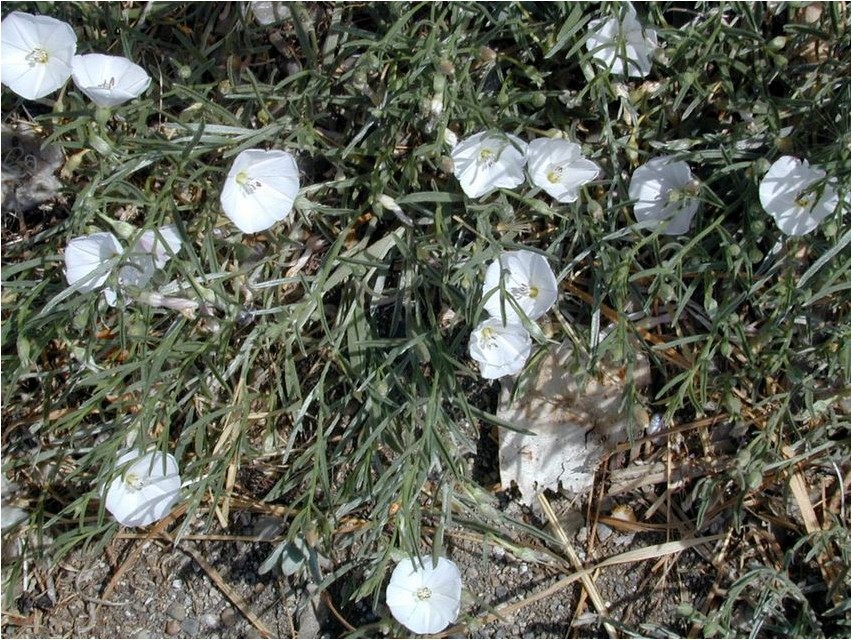
Amman bindweed is one of the plants of the family called Convolvulaceae; in Latin the name of this plant will be as follows: Convolvulus ammanii.
As for the name of the Amman bindweed family itself, in Latin it will be: Convolvulaceae Juss.
Description of Amman bindweed
Amman bindweed is a perennial prostrate herbaceous plant whose length will vary between two and fifteen centimeters. The stems are among several pieces, such stems can be either recumbent or erect. The leaves of this plant are linear, and they taper towards the base; the width of such leaves is approximately half a millimeter to five millimeters. Amman bindweed flowers are located one at a time on the tops of the stems and short lateral branches. The length of the corolla will be about nine to fifteen centimeters, the corolla is painted in whitish or pale pinkish tones. The length of the capsule of this plant will be about four to five millimeters, such a capsule is endowed with a spout, is broadly ovoid, and at the top it will be sparsely hairy.
This plant blooms from May to August. Under natural conditions, Amman bindweed can be found in the Altai region of Western Siberia, as well as in the Daursky and Angara-Sayan regions of Eastern Siberia, as well as in Central Asia. For growth, this plant prefers dry, gravelly, rocky steppe slopes, as well as sandy and desert steppes. In addition, Amman bindweed can also be found in saline coastal meadows, sands and pebbles.
Description of the medicinal properties of amman bindweed
Amman bindweed is endowed with quite valuable medicinal properties; for this purpose it is recommended to use the herb of this plant. The concept of grass includes stems, leaves and flowers. Amman bindweed contains rutin, flavonoids, coumarins, alkaloids, and also carbohydrates. The experiment revealed a depressant effect on the central nervous system of an aqueous extract of grass and roots. However, such an extract will not have a local irritant or anesthetic effect.
In addition, it was shown that in an experiment, the herbal extract of this plant can exhibit inhibitory properties against the so-called parainfluenza virus. In medicine, an infusion or decoction of the herb has become quite widespread. This infusion and decoction of amman bindweed is used to treat pulmonary tuberculosis, fever, syphilis and atherosclerosis.

For mild tuberculosis, it is recommended to prepare the following remedy: to prepare it you will have to take one tablespoon of dry crushed herb per one glass of boiling water. The resulting mixture should be infused for about two hours, and then this mixture should be carefully filtered. It is recommended to take one or two tablespoons of this remedy approximately three to four times a day.
The following remedy is recommended as a lotion and for compresses for wounds. For two parts of bindweed flowers or herbs, take about four parts of vodka or alcohol, this mixture is infused for about two weeks. Then this mixture is carefully filtered and poured into a certain container. One tablespoon of this tincture should be diluted with about half a glass of boiled water.
In cases of fever, atherosclerosis and a tendency to bleeding, the following remedy is recommended: one part of amman bindweed herb should be infused in five parts of seventy percent alcohol, and then it is infused for seven days. You should take the resulting remedy approximately half a teaspoon two or three times a day before meals.





