Pulasan
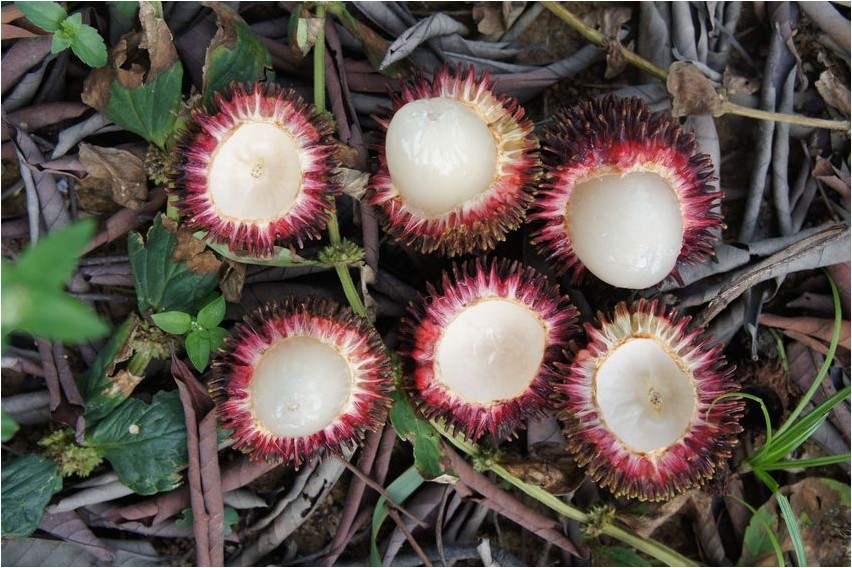
Pulasan (Latin: Nephelium mutabile) is a fruit tree belonging to the Sapindaceae family.
Description
Pulasan, or pulazan, is a fruit tree reaching ten to twelve meters in height. The short, straight trunks of the pulasan are adorned with numerous branchlets extending in different directions. The brown bark of the trees is distinctly rough.
The odd-pinnate or paripinnate leaves of the pulasan are alternate and slightly wavy, each with two to five opposite leaflets. All leaflets have a smooth surface, are dark green in color, and covered with tiny hairs on the underside. The leaf blades can range from ten to thirty centimeters in width and twenty to forty centimeters in length.
The tiny, greenish flowers of the pulasan have four to five pubescent sepals. Pulasan fruits resemble rambutans in appearance, but unlike rambutans, their surface is covered with sparse, shorter hairs. The fruits resemble oval or round berries, reaching five to seven centimeters in diameter. The fragrant, soft, and sweet flesh of the pulasan is creamy or white in color. Each fruit contains several small, light-brown, oblong seeds.
Where it grows
The pulasan is native to the Malay Peninsula. Both cultivated and wild, it can be found in the Philippines, Thailand, and Malaysia. Pulasan is also grown in Cambodia, India, and Australia.
Few people in the Americas know of the pulasan, with the possible exception of Costa Rica, where it is cultivated on a small scale. Uses

Pulasan is eaten fresh or used to make preserves, jellies, and desserts. Roasted or boiled seeds are used to make cocoa.
The roots and leaves of the pulasan plant are widely used medicinally. The pulasan seeds are used to produce an oil used in soap production, while the roots, leaves, and bark are an essential raw material for making natural dyes. The dried fruit peel can still be found in pharmacies in Southeast Asia, where it is considered an effective medicine.
The main disadvantages of the pulasan plant are its extremely poor shelf life and relatively short shelf life. This is why canned fruits are most often exported.
Cultivation
Pulasan is a crop that can grow in almost any soil. And since this plant is very light-loving, it needs to be provided with proper lighting. In addition, it needs regular and abundant watering — this tree is quite moisture-loving. Pulasan is also characterized by being thermophilic — it simply cannot stand low temperatures. If the thermometer drops below ten degrees, this will negatively affect the yield. The most comfortable temperature for this culture will be between twenty-five and twenty-nine degrees.
When planting pulasan, it is important to try to ensure that the distance between the trees is at least eight to ten meters. In principle, this crop does not require special care; the most important thing is to constantly keep the soil moist.
It is noteworthy that after a long drought, pulasan blooms very profusely and produces rich harvests. And it is propagated both through grafting and seeds. At the same time, it can be propagated by budding, air layering, and cuttings. As a rule, grafted trees begin to bear fruit in the third or fourth year of life. And pulasan grown from seeds will delight you with the first harvest only in the fifth year. By the way, these attractive fruits are harvested twice a year: in December and July.
കറുന്ന തേൻപഴം ഫിലോസാൻ Pulasan Plant Malayalam
Pulasan pulasan





