Chaenomeles
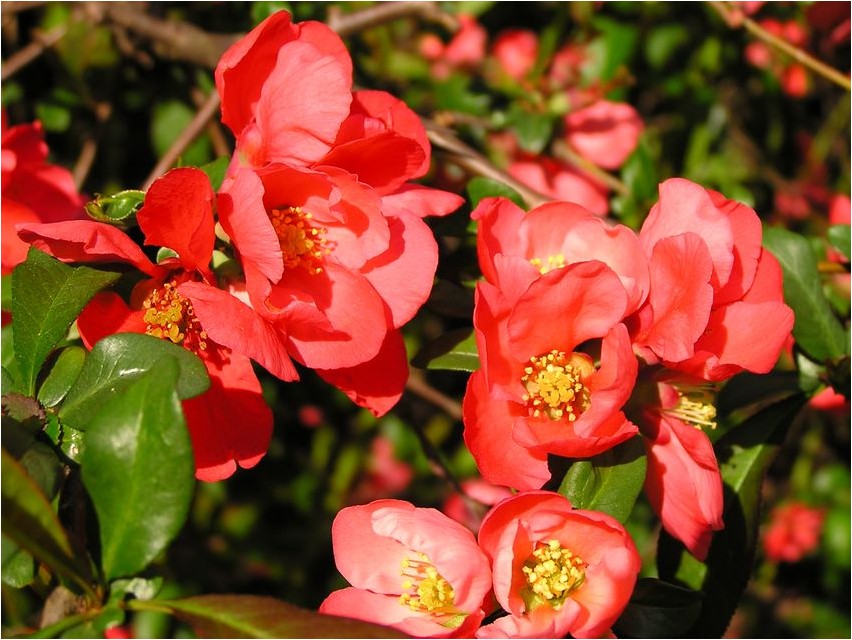
Chaenomeles (Latin: Chaenomeles) is a winter-hardy, light-loving woody plant from the Rosaceae family. It is also known as Japanese quince (this name stems from the fact that its fruit is very similar in shape to the quince).
Description
Chaenomeles is a relatively small tree or shrub with simple leaves, large stipules that remain long-lasting, and large, fragrant flowers.
Chaenomeles flowers can be either single or double, and are arranged rather randomly on the branches—either singly or in spectacular clusters, each containing two to six flowers. Chaenomeles blooms prolifically and for a long time—you can admire its magnificent blooms for almost a month!
The shape of this plant”s fruit can vary greatly, from pear-shaped to apple-shaped. The surface of these fruits can be either ribbed or smooth, with a diameter ranging from three to five centimeters, and sometimes even larger specimens are found. Harvesting Chaenomeles is quite challenging: its fruits are not only located deep within the bushes, but are also reliably protected by thorns decorating the shoots! A single bush can yield up to nine kilograms of fruit.
There are four species in the Chaenomeles genus.
Where it grows
Chaenomeles is quite widespread in Japan, as well as China and distant and mysterious East Asia.

Uses
Chaenomeles is grown primarily as a highly sought-after fruit crop. It is also widely used in landscape design, and is especially often seen in striking arrangements of perennial flowers and a wide variety of woody plants. There are indeed quite a few varieties of the beautiful Chaenomeles bred exclusively for ornamental purposes, and this is a welcome development—all of these varieties boast a wide variety of sizes and colors, and their flowering times also vary. Chaenomeles are also successfully used to create beautifully flowering low-growing borders or hedges.
Cultivation and Care
Chaenomeles should be planted in the sun, trying to choose areas where a sufficiently large amount of snow accumulates in winter, which reliably protects the branches of this plant from damage by frost. This crop will grow and develop well on any, but, importantly, cultivated soils (mainly garden soils), which are not characterized by stagnant moisture. And the most ideal option for chaenomeles would be light loams characterized by a slightly acidic soil reaction.
Chaenomeles is very undemanding in care. It is very responsive to regular feeding, both with mineral fertilizers and organic matter. It should be watered only when drought is established.
Chaenomeles also requires systematic pruning, which consists mainly of thinning, that is, the removal of weak and small shoots located in the very depths of the bushes, as well as the elimination of old shoots that are already more than five or six years old. And in order to rejuvenate the plant, the shoots are cut out completely. At the same time, we should not forget that the main fruiting of Chaenomeles is concentrated on three-year-old branches.
Most often, Chaenomeles is propagated by seeds, and this can be done both in autumn and spring. And large-fruited and especially productive varieties are usually propagated vegetatively — by root shoots, as well as layering or summer cuttings.
By the way, Chaenomeles seedlings can serve as dwarf rootstocks for a number of varieties of apple trees, pears, as well as for some forms of hawthorn and even garden rowan!