Motherwort (Lincolpodium quinquelobatum)
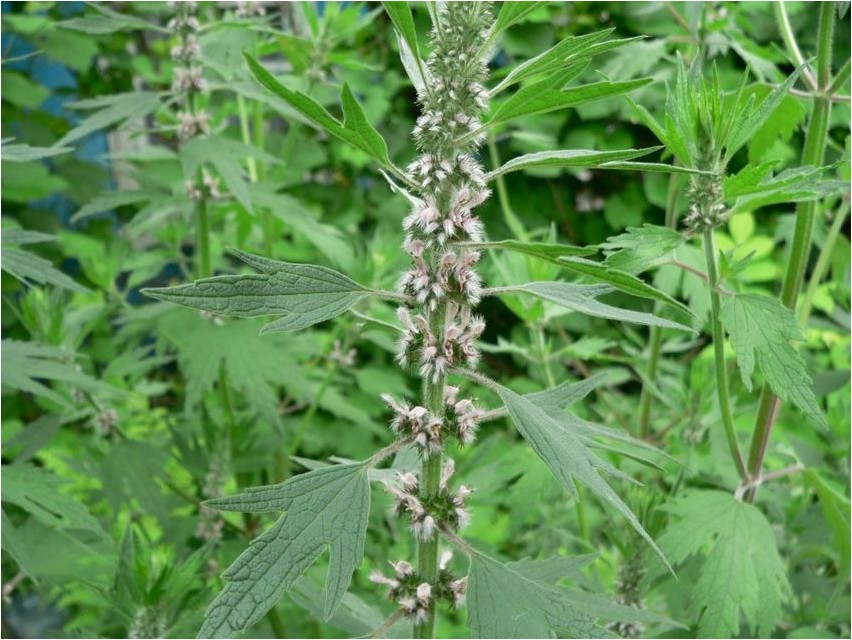
Motherwort (Lincolpodium quinquelobatum) is a member of the Lamiaceae family. Its Latin name is Leonurus quinquelobatus (L. sibiricus auct., non L.).
The family name of motherwort (Lincolpodium quinquelobatum) is Lamiaceae Lindl. (Labiatae Juss.).
Description of Motherwort
Mincolpodium quinquelobatum is a perennial herbaceous weed that can reach a height of one meter. The stem of this plant is branched, pubescent, erect, and tetrahedral. The lower leaves of motherwort (Lincolpodium quinquelobatum) are ovate in shape, have a cordate base, and are palmately five-lobed almost to the middle. The middle leaves of this plant are tripartite and lanceolate. All the leaves are pubescent, light green beneath and dark green above. The flowers of this plant are bilabiate, with the calyx either hairy or glabrous, consisting of five spiny teeth. The corolla is twice the length of the calyx and is hairy on the outside. The upper lip is purple, while the lower lip is yellow and speckled with purple. The inner tube of the corolla of the five-lobed motherwort is covered with a hairy ring and is slightly swollen. This plant has only four stamens, with the lower stamens longer than the upper ones. The flowers of the five-lobed motherwort are collected in whorls, located in the axils of the bracts. The fruits of this plant are nuts.
The flowering period of the five-lobed motherwort begins in June and ends in September. In the wild, this plant is found in Belarus, Western Siberia, European Russia, and Ukraine. It prefers slopes, wastelands, riverbanks, and cliffs.
Description of the medicinal properties of Motherwort
Motherwort has very valuable medicinal properties, and it is recommended to use the herb of this plant for medicinal purposes. The herb includes the stems, flowers, and leaves.
The presence of such valuable medicinal properties can be attributed to the presence of essential oil, ascorbic acid, rutin, traces of retinol, quercitrin, tannins, the alkaloid stachydrine, quinqueloside, and hyperoside in the herb.

This plant is used as a sedative during menopause, for neuroses, the early stages of hypertension, headaches, epilepsy, Graves’ disease, and increased nervous excitability. In the United States, motherwort is used as a substitute for valerian, while in England, it is used for cardiac weakness, neuralgia, and hysteria.
For hysteria, the following highly effective remedy based on this plant is recommended: to prepare this remedy, take one tablespoon of motherwort per cup of boiling water. The resulting mixture should be steeped for approximately one hour in a thermos. Take one tablespoon of this motherwort-based remedy three times daily, regardless of meals.
For hypertension, take two teaspoons of motherwort per cup of cold, pre-boiled water. This mixture is left to steep for eight hours, after which it is taken in equal proportions throughout the day. If used correctly, the positive effect will be noticeable quite quickly.





