Hemlock
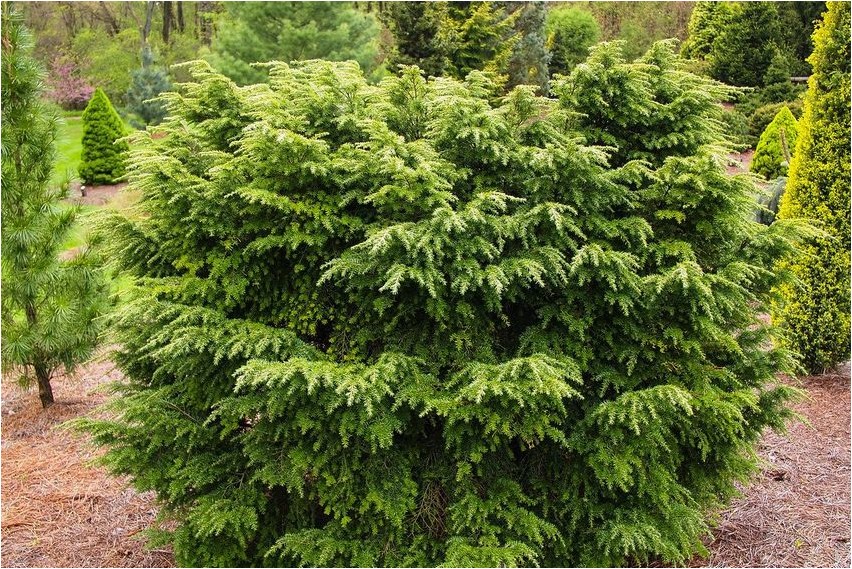
Hemlock (lat. Tsuga) is a genus of evergreen coniferous trees of the Pine family. The genus includes 14 species, according to other sources — 18 species. In nature, hemlock is found in temperate latitudes of North America and Asia.
In Russia, mainly two species are grown: Tsuga diversifolia and Canadian hemlock (Tsuga canadensis).
Characteristics of culture
Hemlock is an evergreen tree up to 65 m high with a conical or asymmetrically ovoid crown and hanging shoots. The bark is scaly, deeply fissured, brown or gray. The branches are curved downwards, often flattened. The leaves are linear-lanceolate or flat, two-rowed, live for several years, after which they fall off. The tip of the leaves is notched, rounded or sharp, the vagina is absent.
The buds are not resinous, round. Female cones are oblong or ovoid, sit on short stalks, full maturity occurs in six months, after the release of the seed they disappear or remain on the shoots. Male cones are round, single, and form after 11-12 months. The scales of the cones are thin, smooth, leathery, and in some representatives of the Hemlock genus they are pubescent.
In appearance, hemlock resembles spruce, especially with its tiered pyramidal crown and hanging young branches. However, hemlock can be distinguished from spruce by its needles and other minor characteristics. Hemlock is a long-liver; there are specimens over 100 years old. Plants retain the ability to form fruits for up to 450 years. Every 3-5 years, hemlock produces increased yields of cones. Cultivated hemlock species live about 100-150 years.
Growing conditions
Hemlock is a shade-tolerant crop, but in maturity it requires a large amount of sunlight. In areas with complete shade, the lower branches of the hemlock become bare, become thin and brittle. Semi-shaded areas are optimal for plants. The soils for growing hemlock are preferably loose, moist and fertile; sandy loam soils are also suitable.

Hemlock has a negative attitude towards acidic and alkaline soils; it accepts slightly acidic and neutral ones. Stagnant water will negatively affect the development of crops, as will cold strong winds. It is mandatory for hemlock to mulch the tree trunk area. Mulch will protect the roots from overheating.
Reproduction and planting
Hemlock is propagated by seeds and cuttings. Decorative forms can be propagated by grafting. Seeds need preliminary stratification for 1-4 months at a temperature of 5C. Sowing is carried out at the end of March — beginning of April in seedling containers.
Cuttings are carried out in September — November. Winter cuttings are also possible. Planting of seedlings is carried out in late August or early spring. The depth of the planting hole is 70-80 cm. The optimal distance between plants is 1-1. 5 m. Hemlock does not tolerate replanting well.
Care
Hemlock is a moisture-loving crop, so regular watering is required. Spraying is encouraged, especially during prolonged drought. Fertilizing has a positive effect on the development of hemlock. It is recommended to use both organic and mineral fertilizers for fertilizing. Loosening and weeding are desirable. Hemlock does not grow quickly, so systematic pruning is not required. For the winter, young plants are covered with spruce branches, which will prevent freezing of shoots and sunburn.
Application
Hemlock is an ornamental plant that looks great in both single and group plantings. The culture is sensitive to air pollution; this factor limits its use in urban landscaping, although it is a frequent guest in public parks. Canadian hemlock is suitable for decorating the banks of artificial and natural reservoirs. Hemlock is also used to create hedges, especially since the plants are easy to trim.