Flatweed
Platycladus (lat. Platycladus) is a coniferous evergreen tree belonging to the Cypress family.
Description
The flatweed is a slowly growing tree of relatively small size, the height of which can vary from five to ten meters. True, sometimes in particularly favorable conditions you can meet specimens up to eighteen meters high or even more. If these trees grow in unfavorable conditions for them, they often take the form of bushes.
Each tree has a shallow root system. As for the trunks, they are in most cases straight, and the diameter of the trunks of mature trees often reaches one meter. Sometimes the trunks are divided near the base into several separate stems that shoot vertically upward. Each trunk is covered with light, thin bark, painted in pleasant reddish-brownish tones. This bark is endowed with the ability to peel off, and it peels off in fairly long strips.
Quite wide fan-shaped (that is, flat-compressed) branches of the flat branch are covered with yellowish-reddish bark and always grow tightly pressed and only directed vertically. They form luxurious wide crowns, characterized by a spectacular cone-shaped shape.
Scale-like or needle-like (needle-like needles can only be found on annual or biennial trees), the needles of trees are always pressed very closely to the branches. Its length varies from one to three millimeters, and it is all painted in pleasant light green tones and endowed with fairly sharp tips. By the way, with the onset of winter the needles turn brown. The needles of the flat branch have another interesting feature — it is characterized by a complete absence of resin glands.
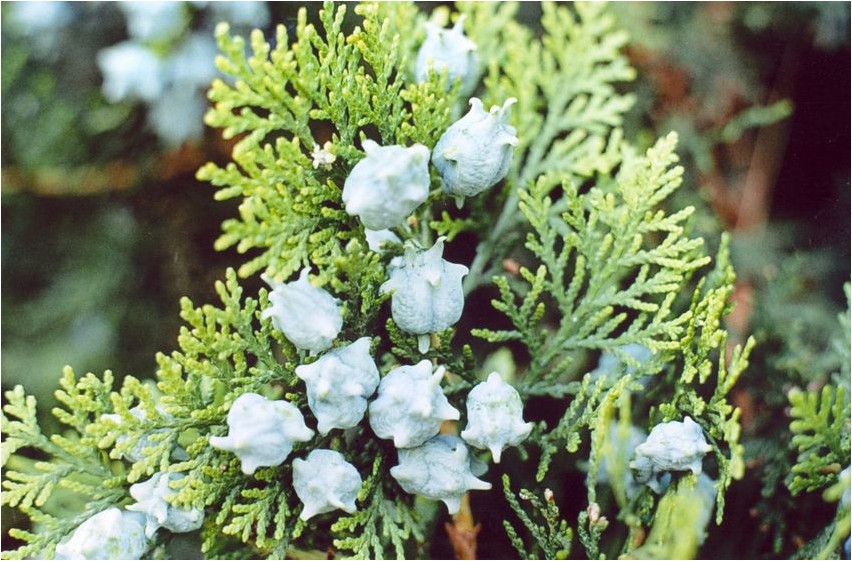
Sitting at the very tips of the shoots, the male greenish-yellowish flowers of the flat branch (often called microstrobilae) boast an attractive elongated shape and reach a length of two to three millimeters. The flat branch begins to bloom with the onset of April. And female cones, called megastrobils, often reach two centimeters and have a very impressive weight — from eight to twelve grams. All of them have an almost spherical shape, are attached to the tips of isolated branches and are endowed with characteristic hook-shaped protrusions. Until the moment of ripening, the female cones are quite soft, and they are covered with a delicate bluish-greenish coating. They ripen after pollination only in the second year, acquiring a reddish-brownish hue upon ripening and gradually becoming woodier. And after a while they also open up. Each cone is formed by six or eight scales fused together and directed upward, with each scale including one or two seeds. The ovoid seeds are reliably protected by thick brownish-brownish shells with white marks near the bases and a spectacular glossy surface. The length of the seeds reaches six millimeters, and their width ranges from three to four millimeters. These seeds do not have wings, and their ripening usually occurs in autumn.

Where does it grow
The natural habitat of the flat branch is considered to be Korea and China.
Usage
Strong and light wood of the flat branch is often used for making furniture, but, alas, it is not suitable for exterior decoration in the construction industry. These trees are also widely used in park construction and for landscaping in various settlements. Flat twigs make luxurious hedges.
Growing and care
Flatweed tolerates drought well, and also boasts excellent resistance to short-term frosts down to minus twenty-five degrees and the ability to grow well in loose, poor soils. It is important to take into account that in cold climates its growth slows down significantly.