Dyeing navel
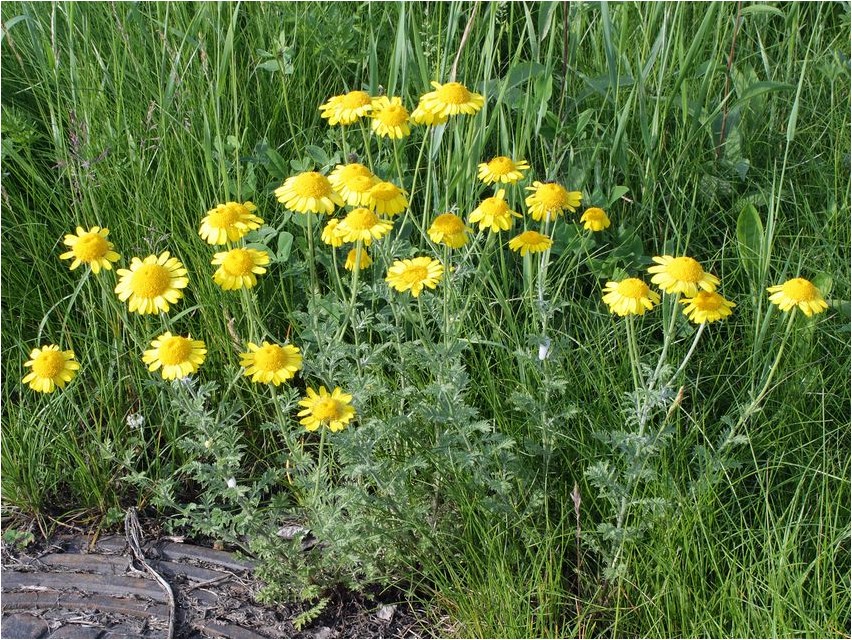
The navel is one of the plants of the family called Asteraceae or Asteraceae; in Latin the name of this plant will sound like this: Anthemis tinctoria L. s. L.
As for the name of the navel plant family itself, in Latin it will be like this: Asteraceae Dumort. (Compositae Giseke).
Description of the dyeing belly button
The dyeing navel is known under numerous popular names: bull’s eye, bodki, field carnations, yellow flowers, kupavki, oxen, yellow flowers, papavka, navel, ramen, forest navels, ramon, wild rowan, field saffron, field chamomile and field caps. The navel is a perennial herbaceous plant, the height of which will fluctuate between thirty and sixty centimeters. Such a plant will be endowed with a spindle-shaped, branched rhizome. The stem of this plant can be either ascending or straight, branched at the top or simple, and such a stem is colored in gray-greenish tones and is covered, along with the leaves, with fine hairy pubescence. The leaves of the navel are doubly pinnately dissected, they are endowed with a serrated shaft, sharp lobes and comb-like segments. At the same time, the flower baskets of this plant are painted in yellow tones, they are quite large in size, located on long stalks. Such flowers of the navel tincture will consist of marginal female pseudolingulate and median tubular flowers. The fruits of this plant are ribbed achenes, the length of which is about five millimeters.
The flowering of the navel tincture occurs in the period from June to July. Under natural conditions, this plant is found in the Caucasus, Central Asia, Belarus, Ukraine, Western and Eastern Siberia, as well as all regions of the European part of Russia, with the exception of the Lower Volga region. For growth, this plant prefers fields, dry meadows and garbage areas.
Description of the medicinal properties of navel dye
The navel is endowed with very valuable healing properties, and for medicinal purposes it is recommended to use the flower baskets and grass of this plant. The concept of grass includes stems and leaves. The presence of such valuable healing properties is recommended to be explained by the content of essential oil, rubber, glycosides, polyacetylene compounds, coloring pigment and quercetin in this plant, which in turn belongs to the vitamin P group.
Scientific medicine recommends the use of this plant for rheumatism, the prevention and treatment of vitamin P deficiency and hypovitaminosis, allergic diseases, typhus, measles, scarlet fever, hemorrhagic diathesis, radiation sickness, thrombocytopenic purpura, capillary toxicosis, septic endocarditis, and is also used in the treatment and prevention of capillaries that are associated with the use of arsenic compounds, anticoagulants and salicylates.

The navel is endowed with very effective anthelmintic, hemostatic, diuretic, antimalarial, diaphoretic and choleretic effects.
A decoction prepared from the herb of this plant along with flower baskets is indicated for use in uterine bleeding, gastralgia, diathesis, various colds, jaundice, and is also used as a choleretic agent.
A decoction based on the inflorescences of the navel is used for diathesis, malaria, acute respiratory diseases, amenorrhea, and externally this healing agent is used for baths and compresses. The powder of the inflorescences of this plant is used internally for helminthiasis.





