Vyazel multi-colored
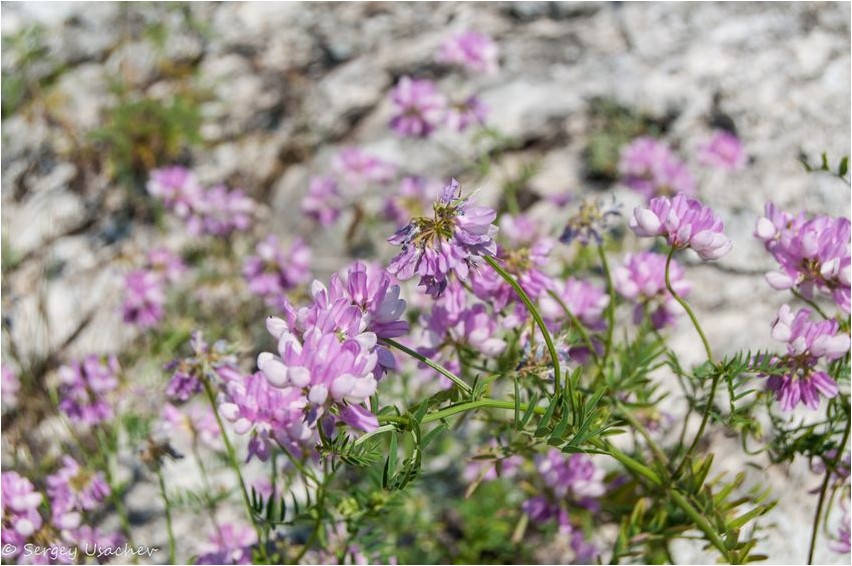
Variegated elm is sometimes also called variegated elm; in Latin the name of this plant will be as follows: Coronilla varia L.
Variegated Elm is one of the plants of the family called legumes, in Latin the name of this family will be: Fabaceae Lindl.
Description of multi-colored knitting
Variegated elm is a perennial herbaceous plant, which is endowed with a creeping and branched rhizome. From such rhizomes, in turn, quite numerous hollow stems will develop.
The leaves of this plant are odd-pinnate and also petiolate. The flowers form capitate and rather short umbels, which are located on long pedicels. The calyx is bell-shaped and equipped with sharp triangular teeth. The corolla is painted in pink or purple tones, and is also endowed with white stripes. This plant will have only ten stamens and they are difraternal. There is only one pistil with an upper single-locular ovary. The fruits are elongated and oval beans, which can be either brown or brown in color. Flowering of the multi-colored knitted plant occurs throughout the entire summer period, and the ripening of seeds will begin around July.
Under natural conditions, this plant can be found in Ukraine, Belarus, Moldova, the Caucasus, as well as in the central and southern zones of the European part of Russia. For growth, this plant prefers meadows, steppes, forest edges, crops, and the plant can also be found on hillsides and among bushes. Variegated Elm is a honey plant, and in addition to this it will also be a poisonous plant. The seeds of the multi-colored bobwhite are especially poisonous.
Description of the medicinal properties of multi-colored knitting
Multi-colored kibble is endowed with quite valuable healing properties, and the seeds and grass of this plant should be used for medicinal purposes. The concept of grass includes the leaves, flowers and stems of this plant. The grass should be collected around May-August, but it is important to collect the seeds already in July-August.

Such valuable medicinal properties are due to the content of starch, nitropropionic acid and its esters in the roots of this plant. At the same time, the above-ground part of the plant will contain tannins, carbohydrates, catechins, organic acids, as well as nitrogen-containing compounds: coronarian, coronillin, cybarian, caracan, and in addition also nitropropionic acid and its esters. In addition, the aerial part of the multi-colored bobwhite contains the following coumarins: daphnoretin, scopoletin and umbelliferone, as well as the following flavonoids: isoorientin, astragalin, trifolin, kaempferol, saponaretin, homoorientin and isovitexin glucosides.
Variegated bobwhite flowers will contain vitamin C, tannins, essential oil, alkaloids and the following flavonoids: trifoline, astragalin and kaempferol. In the seeds of this plant, coumarins, phenolcarboxylic acids, catechins, essential oil, unsaturated fatty acids, uric acid, glycosides coronillin and coronizide, as well as glucose, galactose and polysaccharides were found. It is noteworthy that this plant has not received widespread use in official medicine.
As for traditional medicine, infusions and decoctions of this plant are quite widely used as a cardiac and diuretic. In addition, such infusions are also used for ascites, tuberculosis, fever, dysentery, tumors and diathesis. It should be noted that the internal use of such products requires very great caution, due to the fact that the plant is poisonous.





