Aglaonema
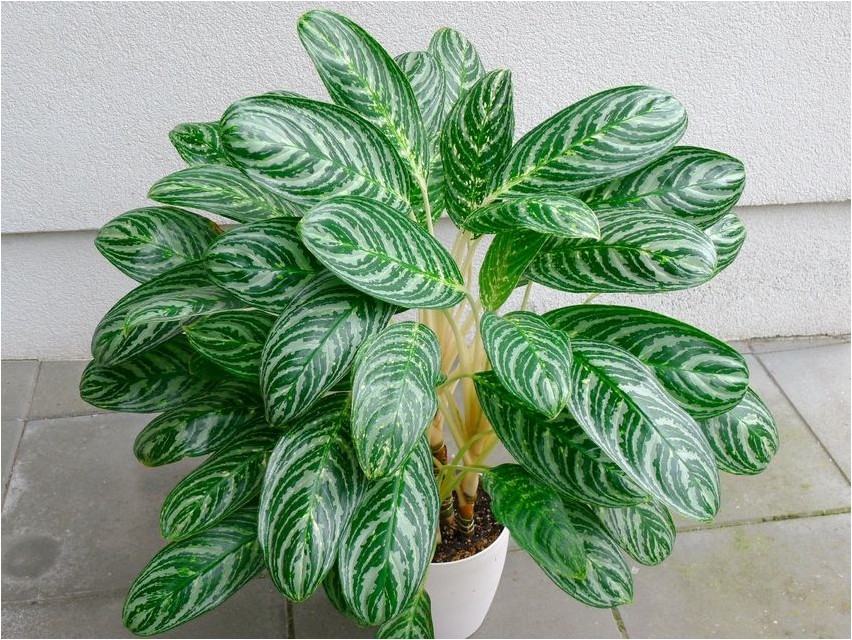
Aglaonema (lat. Aglaonema) is a genus of herbaceous evergreen plants or evergreen subshrubs, donated to nature by the tropical forests of Southeast Asia.
Plants of the genus belong to the Aroid family, or Aronicaceae (lat. Araceae). They are distinguished by large leathery leaves, the bright surface of which has decorative spots or stripes, turning the leaf plate into a real work of art. As for flowering, the inflorescences-cobs of small flowers are of no interest to the viewer, and therefore fans of plants of the Aglaonema genus grow them for the sake of picturesque leaves. In temperate climates, plants of the genus are grown as houseplants.
Description
The vertical stem of the plant is short and does not branch. If the stem is creeping, then it begins to branch, take root at the nodes, taking root and expanding the area occupied by the plant.
Large leaves sit on strong and long petioles, forming a lush crown of the plant. The shape of the leaf blade is most often oval-ellipsoidal. The picturesqueness of the leaves is given by veins that fan out from the central main vein to the edges of the leaf blade, sometimes forming small teeth along the edge and giving the leaf the appearance of a convex surface.
The variety of colors and patterns on the surface of the leaf is so numerous that it is perhaps impossible to find two leaves with the same pattern on the same plant. In the coloring of miraculous paintings, in addition to green of various shades, silver, red of various shades, yellow, violet are involved..
The inflorescence has a very peculiar cover that protects the inflorescence-cob, formed by monoecious small flowers. The female part of the inflorescence is quantitatively inferior to the male part, located in the lower zone of the inflorescence-cob.

The growing season ends with the birth of fruits, which are oval-shaped berries with a fleshy outer layer. As if trying to justify the inconspicuousness of the inflorescences, the berries are usually brightly colored and can be red, yellow or white.
Plants of the Aglaonema genus are characterized by slow growth, and therefore do not require much space indoors.
Varieties
* Aglaonema changeable (lat. Aglaonema commutatum) – many varieties have been bred, differing from each other in the number of spots on the leaves, colored silver of varying intensities.
The most popular variety among gardeners is “Silver Queen” with long, bright green leaves, the surface of which is decorated with silver spots. The higher the temperature and illumination of the place where the “queen” grows, the larger the silvery spots become, sometimes turning the entire surface of the leaf into “silver”.
This variety is inferior to “Silver King”. Like a true gentleman, he does not strive for lush forms, forming a more compact bush, and also has a lighter pattern on the surface of the leaf plate.
* Aglaonema modest, or moderate (lat. Aglaonema modestum) – Google translator translated the Latin specific epithet as “gentle”, which is quite consistent with this species with monochromatic green leaves, which, despite their leatheriness, create a very gentle impression. The plant is suitable for aquariums.
* Simple Aglaonema (lat. Aglaonema simplex) – has a synonymous name, Alpine Aglaonema. It is distinguished by thick fleshy roots, solid green leaves, the reverse side of which is a lighter green shade. Although the leaves are considered evergreen, they do not live very long, falling off and leaving the stem bare. The plant is suitable for aquariums.
* Aglaonema tricolor (lat. Aglaonema pictum) – leaves of this species combine three colors on one leaf plate in the form of spots, stripes, strokes or dots. It can be green with three contrasting shades, or green in combination with red, yellow, white, purple, or silver.