Almond
Almond (Prunus dulcis) is a subgenus of shrubs or small trees in the genus Prunus in the Rosaceae family. Previously, the plant”s Latin name was Amygdalus communis or Prunus amygdalus. This crop is often classified as a walnut tree, but this is a misconception.
Distribution
Almonds grow naturally in Central and Western Asia and the Mediterranean region. Typical habitats are rocky and gravelly slopes at altitudes of 800-1600 meters above sea level, and less commonly on the coast. Today, large almond plantings can be found in China, the USA, the Caucasus, Crimea, Central Asia, Tajikistan, the Western Tien Shan, and the Kopetdag Mountains. Almonds are also cultivated in small quantities in the Czech Republic and warmer regions of Slovakia. Crop Description
Almond is a shrub or small tree up to 10 m tall with a rounded, pyramidal, weeping or spreading crown and a robust root system, with individual roots extending 4-5 m deep. Shoots are of two types: shortened generative shoots and elongated vegetative shoots. The leaves are lanceolate, with a pointed tip, and borne on petioles. Flowers are white or light pink, solitary, up to 2. 5-3 cm in diameter. The calyx is cup-shaped, symphylolate. The corolla is red or pink.
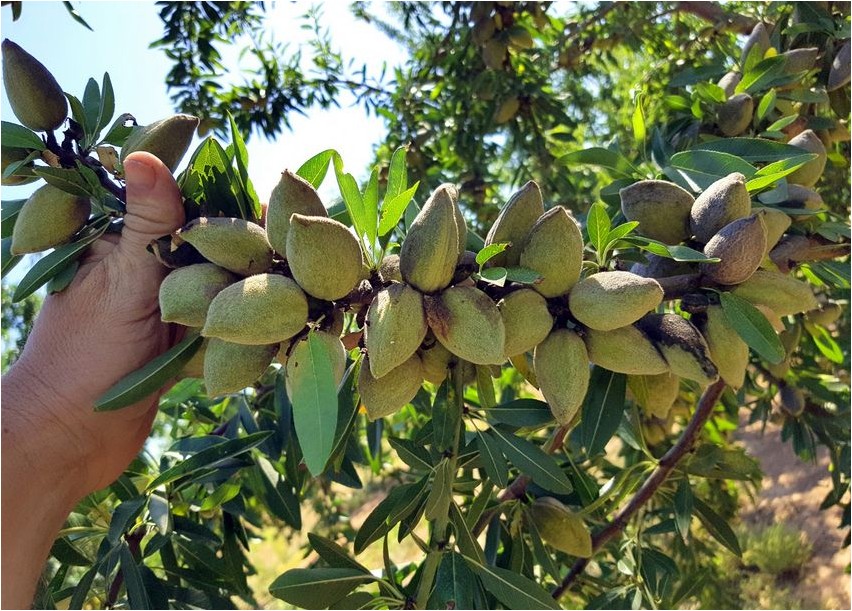
The fruit is a dry, velvety, oval-shaped drupe. The pericarp is leathery, green, fleshy, and inedible. When ripe, the pericarp easily separates from the pit. The pits are covered with small pits or grooves over their entire surface, very similar in appearance to apricot or peach pits. Almond trees bloom in March-April, or February in some regions, and ripen in June-July. They bear fruit for 30-50 years, and can live up to 130 years. They are not known for their cold tolerance, although some varieties can withstand temperatures as low a s-25°C.
Growing Conditions
Thanks to their well-developed root system, the plant is quite drought-resistant. It can grow without problems in dry soils, but moist soils produce high-quality fruit yields. Light clays and loams, as well as ordinary chernozems, carbonate soils, and leached soils with a high lime content are optimal. Acidic, highly waterlogged, and saline soils are not suitable for growing almonds. A sunny location, protected from cold, piercing winds, is preferable.
Propagation and Planting

Almonds are propagated by seeds and budding (grafting). The second method is more common. The rootstocks are seedlings of peach, sweet or bitter almonds, plums or cherry plums. Vaccination is carried out at the age of two. Planting of seedlings is carried out in early spring or autumn according to the 7 * 4 m or 7 * 5 m scheme. Since almonds are a cross-pollinated plant, 4-6 pollinating varieties must be planted on the site.
Almonds are sown in the fall. Spring sowing is not prohibited, but in this case the seeds are subjected to three-month stratification. Stratify the seeds in damp sand in a room with a temperature of 2-5C. When sowing in autumn, seeds undergo natural stratification. Entries are developing very quickly. When the seedlings reach 30 cm, they are planted in a permanent place. Young plants tolerate replanting well and bloom already in the third year.
Care
In principle, crop care is standard. An important maintenance task is formative pruning. This procedure allows you to get bushes and trees with a beautiful compact crown. Sanitary pruning is also necessary; it involves removing dry, weakly growing and damaged shoots.
The first pruning is carried out immediately after planting; annual seedlings are shortened at a height of 80-100 cm. The shoots on the trunk are cut into rings, and in the crowning area they are shortened by two or three eyes. In 3-4 years, it is important to form a cup-shaped crown, similar to a peach. In the future, formative pruning comes down to removing thickening branches and fatty shoots. Rejuvenating pruning for almonds is possible.
Weeding, loosening and watering are also vital for the normal development of almonds. Plants respond well to fertilizing. In the fall, organic matter (compost, manure or diluted bird droppings), potassium and phosphorus fertilizers are added to the tree trunk zone, and nitrogen fertilizers are added in the spring.
ALMOND. How to get a harvest from an almond tree
Almonds are propagated by seeds and budding (grafting). The second method is more common. The rootstocks are seedlings of peach, sweet or bitter almonds, plums or cherry plums. Vaccination is carried out at the age of two. Planting of seedlings is carried out in early spring or autumn according to the 7 * 4 m or 7 * 5 m scheme. Since almonds are a cross-pollinated plant, 4-6 pollinating varieties must be planted on the site.
Almond
Almond (Prunus dulcis) is a subgenus of shrubs or small trees in the genus Prunus in the Rosaceae family. Previously, the plant”s Latin name was Amygdalus communis or Prunus amygdalus. This crop is often classified as a walnut tree, but this is a misconception.
Distribution
Almonds grow naturally in Central and Western Asia and the Mediterranean region. Typical habitats are rocky and gravelly slopes at altitudes of 800-1600 meters above sea level, and less commonly on the coast. Today, large almond plantings can be found in China, the USA, the Caucasus, Crimea, Central Asia, Tajikistan, the Western Tien Shan, and the Kopetdag Mountains. Almonds are also cultivated in small quantities in the Czech Republic and warmer regions of Slovakia. Crop Description
Almond is a shrub or small tree up to 10 m tall with a rounded, pyramidal, weeping or spreading crown and a robust root system, with individual roots extending 4-5 m deep. Shoots are of two types: shortened generative shoots and elongated vegetative shoots. The leaves are lanceolate, with a pointed tip, and borne on petioles. Flowers are white or light pink, solitary, up to 2. 5-3 cm in diameter. The calyx is cup-shaped, symphylolate. The corolla is red or pink.
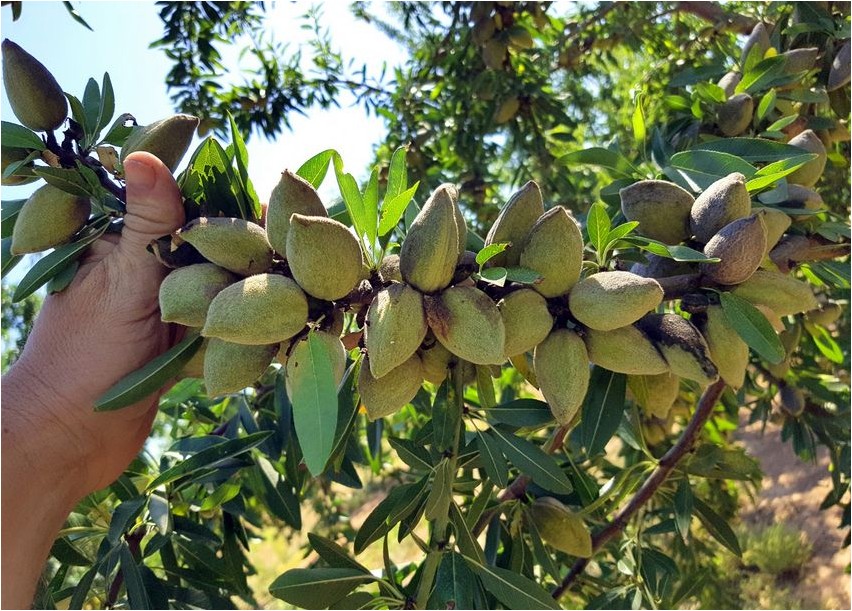
The fruit is a dry, velvety, oval-shaped drupe. The pericarp is leathery, green, fleshy, and inedible. When ripe, the pericarp easily separates from the pit. The pits are covered with small pits or grooves over their entire surface, very similar in appearance to apricot or peach pits. Almond trees bloom in March-April, or February in some regions, and ripen in June-July. They bear fruit for 30-50 years, and can live up to 130 years. They are not known for their cold tolerance, although some varieties can withstand temperatures as low a s-25°C.
Growing Conditions
Thanks to their well-developed root system, the plant is quite drought-resistant. It can grow without problems in dry soils, but moist soils produce high-quality fruit yields. Light clays and loams, as well as ordinary chernozems, carbonate soils, and leached soils with a high lime content are optimal. Acidic, highly waterlogged, and saline soils are not suitable for growing almonds. A sunny location, protected from cold, piercing winds, is preferable.
Propagation and Planting
Almonds are propagated by seeds and budding (grafting). The second method is more common. The rootstocks are seedlings of peach, sweet or bitter almonds, plums or cherry plums. Vaccination is carried out at the age of two. Planting of seedlings is carried out in early spring or autumn according to the 7 * 4 m or 7 * 5 m scheme. Since almonds are a cross-pollinated plant, 4-6 pollinating varieties must be planted on the site.
Almonds are sown in the fall. Spring sowing is not prohibited, but in this case the seeds are subjected to three-month stratification. Stratify the seeds in damp sand in a room with a temperature of 2-5C. When sowing in autumn, seeds undergo natural stratification. Entries are developing very quickly. When the seedlings reach 30 cm, they are planted in a permanent place. Young plants tolerate replanting well and bloom already in the third year.
Care
In principle, crop care is standard. An important maintenance task is formative pruning. This procedure allows you to get bushes and trees with a beautiful compact crown. Sanitary pruning is also necessary; it involves removing dry, weakly growing and damaged shoots.
The first pruning is carried out immediately after planting; annual seedlings are shortened at a height of 80-100 cm. The shoots on the trunk are cut into rings, and in the crowning area they are shortened by two or three eyes. In 3-4 years, it is important to form a cup-shaped crown, similar to a peach. In the future, formative pruning comes down to removing thickening branches and fatty shoots. Rejuvenating pruning for almonds is possible.
Weeding, loosening and watering are also vital for the normal development of almonds. Plants respond well to fertilizing. In the fall, organic matter (compost, manure or diluted bird droppings), potassium and phosphorus fertilizers are added to the tree trunk zone, and nitrogen fertilizers are added in the spring.
ALMOND. How to get a harvest from an almond tree