Shallot
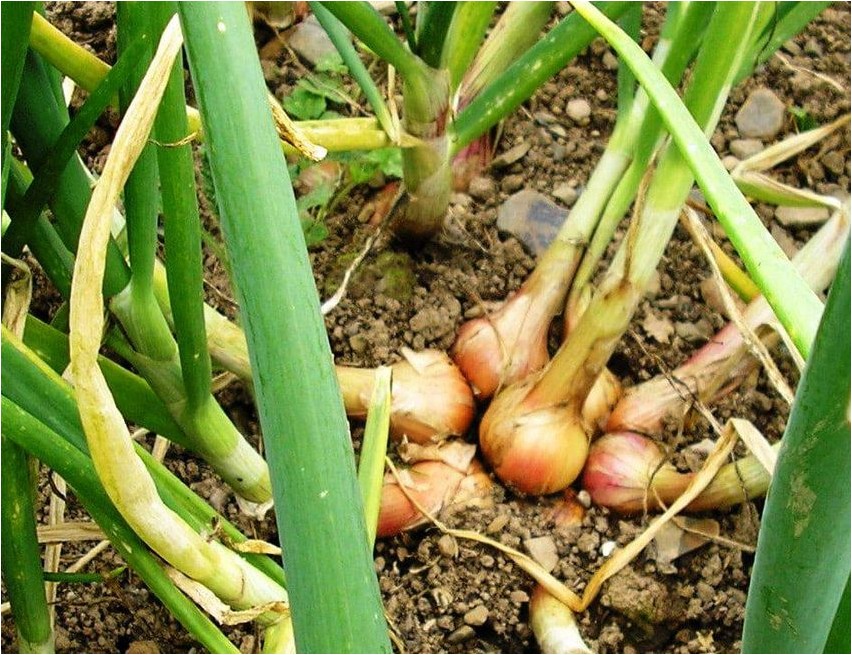
shallot (Latin: Allium ascalonicum) is a vegetable crop; a perennial plant in the onion family. Another name is Ashkelon onion. The plant is also known as sorokozubka, kushchevka, and family onion.
The plant”s native land is Asia Minor. In the wild, the plant is found in Moldova, the Caucasus, Western Europe, and Ukraine. Shallots are also widely cultivated in Russia. In appearance, shallots are similar to onions, although they have minor differences.
Crop Characteristics
Shallots are herbaceous onions that form clusters of 4-5 bulblets in the first year of life. In the second year, newly planted bulblets form clusters containing 8-25 (sometimes even 40) bulblets weighing 25-50 grams each. Shallot bulbs are multi-embryonic, producing up to 20 smooth, 40-70 cm tall scapes. Depending on the variety, the bulbs can be round, oval, or round-flat. They are attached to the base (heel) of the mother bulb and are often irregular in shape.
The bulb scales can be white, light yellow, brown, purple, or pink. When planted in the ground, the mother bulb produces a cluster of aromatic, compactly arranged, juicy, awl-shaped, fistulous, green or dark green leaves up to 30 cm long, covered with a light waxy coating. Unlike onions, shallot leaves are more tender and retain their quality much longer, making this variety of onion suitable for forcing green onions. Growing Conditions
Growing shallots is relatively straightforward and is very similar to growing onions. The plant prefers sunny sites with moderately moist, loose, and highly fertile soils with a pH of 6. 0-6. 5. The best predecessor crops are broad beans, beans, and peas. When growing shallots, it”s important to follow crop rotation rules; the crop should not be replanted in the same location for at least 3-4 years. It”s beneficial to plant shallots close to carrots. The aroma of each vegetable repels pests from the neighboring plant.

Growing Shallots for Green Leaves
Many gardeners grow shallots for their green leaves. This is understandable, as their leaves rarely bolt and, when regularly cut, do not become rough, preserving their nutritional and flavor qualities. To obtain a good harvest of greens, a minimum amount of planting material is required, which is why shallots are considered the most profitable in this regard.
Shallot leaves are cut off when they reach a height of 20-25 cm, as a rule, this happens 30-35 days after planting. And this is another advantage of shallots over onions. The shallot is also a winner in terms of frost resistance; it can be planted at the end of April and before winter in October. In the latter case, the harvest of green leaves can be obtained already at the end of May.
To obtain green feathers, shallots are grown not only in unprotected soil, but also in containers on a windowsill, balcony or greenhouse. Since the plant has a fairly long dormant period, it is planted indoors at the end of February, not earlier. Reuse of bulbs is not prohibited. After the greenery harvest is cut, the bulbs are dug out of the soil, trimmed and replanted.
Growing shallots for turnips
Growing shallots for turnips also has its advantages. The culture produces early harvests of turnips, usually they ripen 2-2. 5 months after planting; for onions, the growing season lasts up to 3. 5-4 months. Shallot bulbs are stored better, sometimes up to 6-7 months even in room conditions. Shallots are denser, although not large in size. If we talk about productivity, then there is no exact answer. Under equally favorable growing conditions, the yield of onions is significantly higher than that of shallots. But when growing shallots on compost beds, its productivity increases, so from 1 square meter you can get up to 4-5 kg of green feathers and up to 3-4 kg of bulbs, which indicates a 300% increase in relation to the planted material.
Care
Caring for shallots involves systematic watering, loosening the soil and weeding. Watering is important at the initial stage of the growing season. 30 days before the expected onion harvest, watering is stopped. Shallots also need fertilizing; experienced agronomists advise using slurry and urea after each cutting of a green feather, and potash fertilizers and wood ash at the beginning of the formation of bulbs. To obtain larger bulbs, in the first ten days of July, some of the small bulbs are removed from the nest. They tear off small bulbs along with the feather, but very carefully.
Why do we need shallots





