Sapodilla
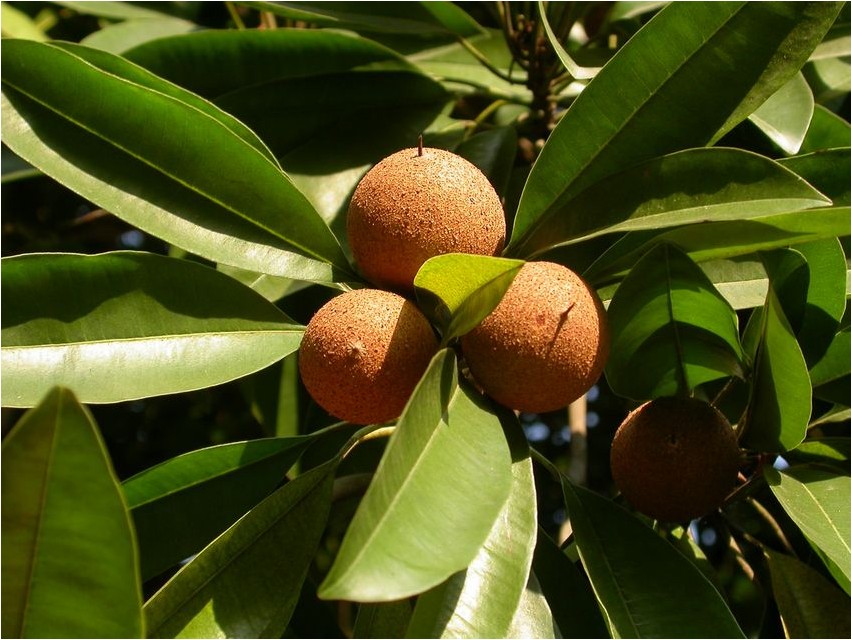
Sapodilla (Latin: Manilkara zapota) is a fruit tree belonging to the Sapotaceae family.
Description
Sapodilla is a slow-growing evergreen tree with a pyramidal crown, reaching a height of eighteen to thirty meters. If its bark is damaged, a sticky white latex will ooze from the tree.
The glossy, elliptical leaves of the sapodilla are two and a half to four centimeters wide and seven and a half to eleven centimeters long.
The tiny sapodilla flowers have three brownish, hairy sepals surrounding pale green corollas and six stamens.
The oval or round sapodilla fruits weigh between one hundred and one hundred and seventy grams each and reach five to ten centimeters in length. Their structure is very similar to that of a persimmon. Ripe fruits are covered with a thin, dull, rusty-brown or pale brown skin. The flesh is also brown, juicy, and soft, with a slight pinkish or yellowish tint. Unripe fruits are usually sticky, hard, and astringent. Each sapodilla fruit contains three to twelve shiny, hard, oval-shaped, black seeds. Each seed is slightly flattened and measures between one and a half and two centimeters in length. The tips of the seeds have hooks that can easily become ingested. To prevent this, remove the seeds before eating the fruit; they easily separate from the flesh.
Where it grows
Sapodilla is native to southern Mexico. Today, this plant is grown throughout tropical America, Indonesia, India, Pakistan, Vietnam, and Malaysia, as well as in the Philippines and Sri Lanka.

Uses
Ripe sapodilla fruits are often eaten fresh—their sweet, rich flavor, somewhat reminiscent of dates and figs, is enjoyed by many. Incidentally, this fruit is often called “fig kiwi” or “sweet potato” due to their similar appearance (oval fruits covered with thin, pale brown skin). Sapodilla is also stewed with ginger and lime juice, fermented into wine, and used in pies.
Sapodilla trees are also grown for their latex (milky sap), which is used to make the base of chicle, a chewing gum.
Rich in tannin, unripe fruits are widely used as an antidiarrheal. A decoction of the bark of this plant is used as an antidysenteric and antipyretic, and a decoction of its leaves, combined with chayote leaves, helps lower blood pressure. A liquid extract obtained from crushed seeds is an excellent sedative.
Sapodilla should be consumed no later than two days after purchase; after this time, its aroma changes dramatically, and not for the better. It can be stored in the refrigerator for five to seven days. Slightly soft fruits with intact skin are considered the most suitable for consumption.
It is worth noting that sapodilla oil is widely used in cosmetics. It is especially beneficial for dermatitis-prone and problematic skin. This oil is also used to strengthen hair (especially brittle and dry hair), to care for inflamed and reddened eyelids, and as part of a comprehensive treatment for a wide variety of fungal skin infections. It”s also ideal for dry skin, especially in regions with harsh weather conditions or calcareous water. This miraculous remedy also helps even out skin tone and heal burns.