Albizia
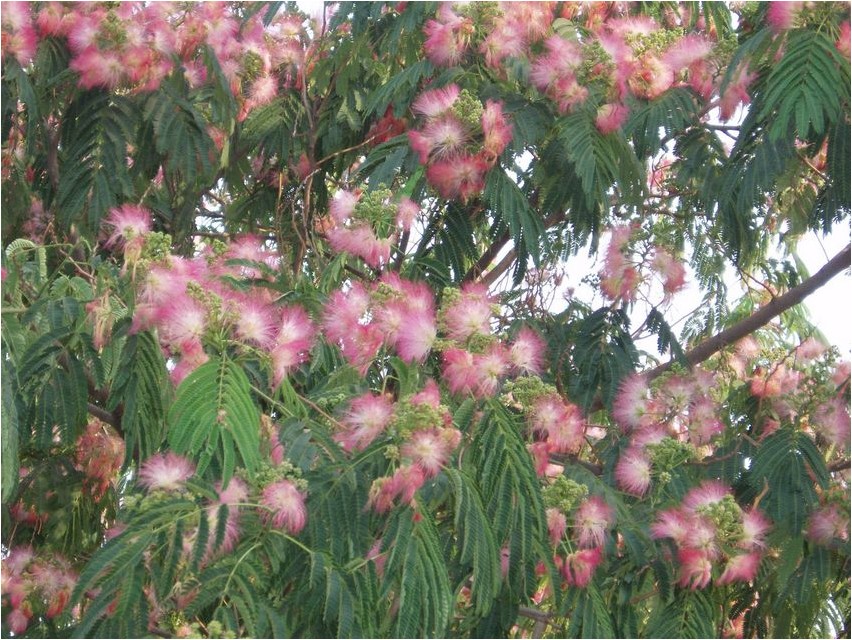
Albizia (lat. Albizia) is a genus of shrubs and trees belonging to the Legume family. The genus received its name in honor of the Italian botanist F. Albizzi.
It was he who brought this unique plant from Constantinople (now Istanbul, Turkey) to Italy back in the 1740s. Representatives of the genus are popularly called silk bush. In its natural environment, Albizia is found in tropical countries, including Australia and New Guinea. Is a long-liver.
Characteristics of culture
Albizia is represented by shrubs and trees with a height of no more than 6 m, although in nature you can find representatives with a height of 15-20 m. Albizia is characterized by an umbrella-shaped openwork crown, with a diameter of up to 5-7 m. The foliage of the plants is pinnately dissected, openwork, endowed with an openwork edge, the color is green or light green, often with a whitish tint on the inside.
The flowers are white with pink stamens, collected in fluffy paniculate inflorescences. Flowering begins in mid-May and lasts until the third ten days of August — the first ten days of September. The fruits are multi-seeded, rather flat beans from 15 to 20 cm long. At first the beans are green, then they acquire a straw, brown or brown color.
One of the most common species is Lankaran albizia (lat. Albizia julibrissin). The plant is characterized by unpaired bipinnate foliage, divided into 9-15 small lobes, which, in turn, bear from 15 to 30 leaves endowed with small petioles. The foliage is dark green, whitish underneath. The flowers are white with a yellowish tint, the stamens are pink or pink-white. The flowers are collected in corymbose paniculate inflorescences. The fruits are elongated, oval-shaped, flat, first green, then brown or brown.
Features of cultivation
Albizia is most often grown by seed. Sowing is carried out indoors in the third ten days of February — the first ten days of March. Before sowing, seeds are soaked in warm water and allowed to swell. Sow seeds in wide pots filled with sand and peat soil. The depth of embedding is 1 cm.

It is advisable to sow in separate containers; if sowed in a box, the distance between sowings should be at least 10 cm. Watering is carried out from a spray bottle, and then covered with film and placed on the windowsill. The optimal growing temperature is 20-25C. It is important to systematically remove the film for ventilation and watering.
It is important to remember that Albizia is a heat-loving plant. It can be cultivated in open ground only in the southern regions of the country. In central Russia, cultivation is possible only in indoor conditions. Planting in open ground is carried out the next year after planting. It is recommended to plant in a well-lit area with diffused light during the midday hours. The preferred soil is rich, loose, permeable. Albizia will not tolerate coexistence with damp, heavy and poor soil.
Cultivation care
One of the important manipulations for caring for a crop is watering, especially in the heat. But you need to remember that Albizia does not like waterlogging. Dampness is harmful to plants. It is also necessary to regularly loosen the soil; the formation of compactions is unacceptable. Don”t neglect mulching. Any natural material, such as grass clippings or fallen leaves, can be used as mulch.
Feeding is required. In total, three feedings should be carried out during the season. The first in early spring at the time of bud break using nitrogen-containing fertilizers. The second at the time of formation of inflorescences through complex mineral fertilizers. The third in the third ten days of August using potassium and phosphorus fertilizers. Nitrogen fertilizers are not required during the third feeding, as they provoke the formation of new shoots that do not have time to ripen before the onset of cold weather and freeze.





