Camellia
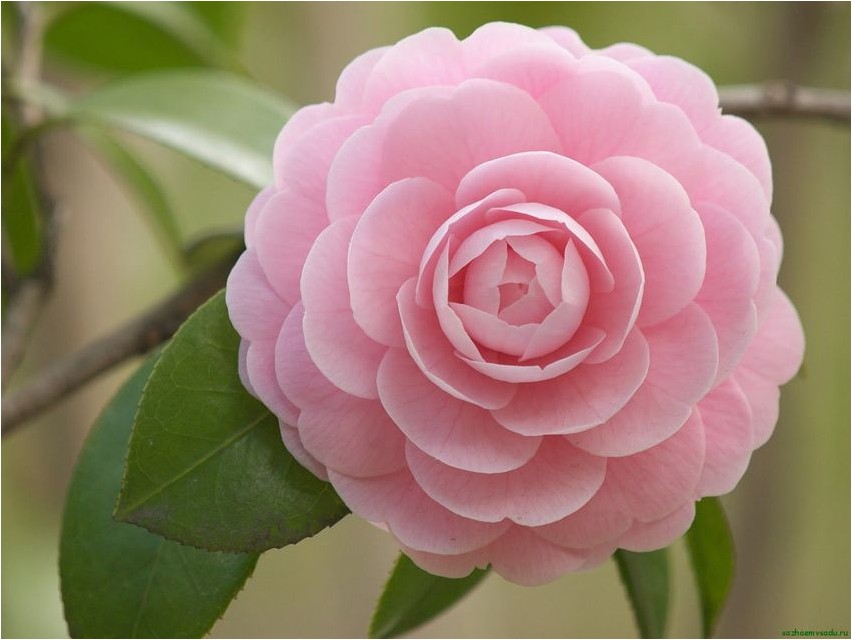
Camellia (lat. Camellia) is a genus of evergreen plants of the Tea family. The most common species is considered to be the Chinese camellia, or tea bush (lat. Camellia sinensis).
Most of the known species have been used in ornamental gardening for a long time. The genus was named after the Czech botanist and physician Georg Joseph Kamel. Currently, representatives of the genus are widespread in southern Russia, the southern United States and other countries with a subtropical climate.
Characteristics of culture
Camellia is a subshrub, shrub or tree 2-20 m high. The leaves are leathery, simple, broadly ovate, oblong-ovate or elliptical, glossy, obtuse or pointed, sitting on short petioles alternately. The flowers are single, red, pink, white or variegated, up to 12 cm in diameter. The fruit is a dry capsule with five chambers, containing 8 seeds.
Growing conditions
The location for plants is preferably sunny. In shady areas, camellias develop much worse and practically do not bloom. Soils are desirable fertile, moderately moist, non-acidic. It is not recommended to grow the crop in waterlogged, waterlogged and saline soils.
Reproduction and planting
Camellias are propagated by sowing seeds and cuttings. Seed propagation is most often used for breeding purposes (for rootstocks and cultivation of various species). Seeds are sown in seedling boxes or pots. Picking is carried out in the phase of 2-3 true leaves. Camellias grown from seeds grow rather slowly and bloom only in the fifth year after sowing, and sometimes even in the eighth year, which completely depends on the species and variety. Camellia seeds lose their viability very quickly, so sowing is done immediately after collection, that is, in September-October. Spring sowing is possible, but only with preliminary stratification, which is carried out in moistened peat, sawdust or sand at a temperature of about 10C.
Cuttings are an equally effective method. Vegetative propagation allows preserving varietal characteristics. Cuttings are cut from the apical non-lignified shoots. The optimal cutting length is 6-8 cm. The cuttings are planted in boxes with drainage holes filled with a substrate consisting of sand and peat soil. The cuttings will take root within 2-3 months. The cuttings must be regularly sprayed and the substrate must be watered. With the appearance of a well-developed root system, the cuttings are transplanted into separate pots with peat, leaf and turf soil and sand in a ratio of 2:2:1:1.

Some varieties of camellias are propagated by grafting (by copulating into a split or into a butt). This procedure is carried out in January. The grafted plants are shaded for the first time; it is also important to maintain optimal humidity and trim the shoots as necessary. Transplantation of camellias propagated in this way is transplanted into pots with a diameter of 9-11 cm the next year, and into pots with a diameter of 11-14 cm in the third year. The composition of the mixture is the same as for cuttings.
Application
Due to their decorative properties, camellias are widely used in indoor and garden design. They are grown in parks, gardens and alleys; some species are used for landscaping offices, apartments and houses. Camellias look great in group and single plantings and are suitable for many types of flower beds, including rockeries and rock gardens. Some species are used to obtain essential oils, for example, Camellia eugenola (lat. Camellia sasanqua).


