Sandy sedge
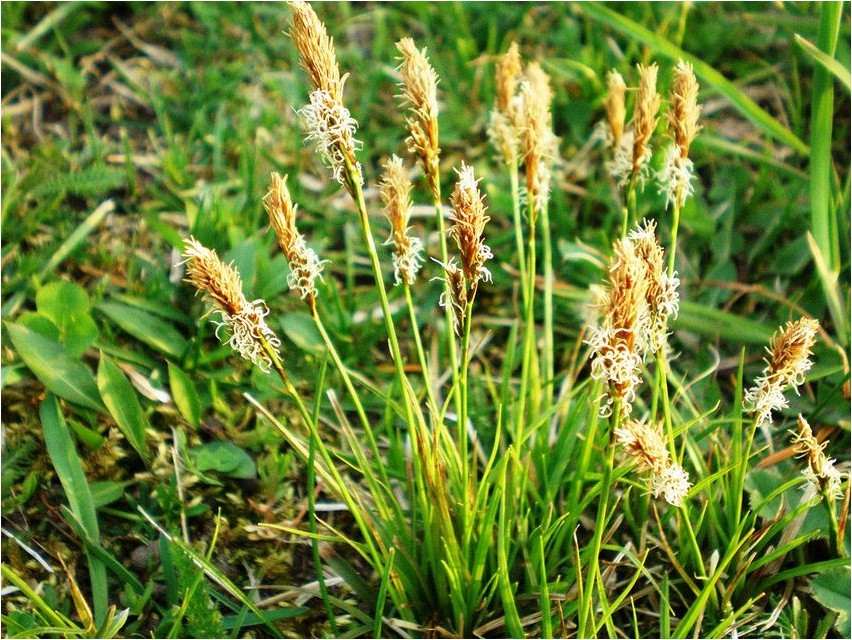
Sand sedge is one of the plants of the family called sedges; in Latin the name of this plant will be as follows: Carex arenaria L.
As for the name of the sand sedge family itself, in Latin it will be: Cyperaceae Juss.
Description of sandy sedge
Sandy sedge is also known under the following popular names: sandy root, sootnitsa, carousel, pestle and sandy sedge. Sand sedge is a perennial herbaceous plant endowed with a rather long, cord-like rhizome, the length of which can reach ten meters. The stems of this plant will be rough at the top and are also triangular. Sand sedge leaves will be grooved, hard, rough and narrowly linear. The flowers of this plant are collected in quite numerous spikelets, which in turn come together to form a linear-oblong spike. The lower spikelets of sandy sedge will be endowed with pistillate flowers, and the upper ones with staminate flowers, the middle spikelets are located at the top and are also endowed with staminate flowers. There are only three stamens of this plant. The ovary of this plant will be single-locular; it is enveloped in a shell, which is an oblong-ovoid sac. Such a sac will be brown, pointed, endowed with strongly prominent veins, which will bear a thread-like column with a bipartite stigma.
The fruit of sandy sedge is a nut that will be enclosed in a pouch. This plant blooms at the beginning of summer. Under natural conditions, this plant is found in the Crimea, Ukraine, Europe and the European part of Russia. Sandy sedge prefers seashores and sandy places to grow.
Description of the medicinal properties of sand sedge
Sand sedge is endowed with very valuable healing properties, and it is recommended to use the rhizomes of this plant for medicinal purposes. It is recommended to harvest such raw materials after the plant has withered. Rhizomes should be cleared of roots and stems, and such raw materials can be stored for three years. The presence of such valuable healing properties should be explained by the content of starch, coumarins, resins, silicic acid, bitterness, essential oil and tannins in this plant.
The rhizome of this plant is endowed with a very effective diaphoretic, anti-inflammatory, emollient, diuretic, analgesic, choleretic, expectorant and metabolism-improving effect.

As for traditional medicine, sandy sedge has become quite widespread. Infusion and decoction prepared from the rhizomes of this plant are recommended for use for bronchitis, pneumonia, severe cough, chronic colitis, pulmonary tuberculosis, flatulence, gout, runny nose, and bronchial asthma. Also, such remedies are effective for the following skin diseases: lichen planus, vasculitis, eczema, neurodermatitis, psoriasis and furunculosis.
In German folk medicine, similar remedies are used to treat constipation, bronchitis, gout, pleurisy, rheumatism and to improve digestion.
For gout, pulmonary tuberculosis, anemia, bronchitis and various diseases of the gastrointestinal tract in England, a decoction based on sandy sedge is used. In Bulgarian folk medicine, the rhizomes of this plant are used as decoctions and infusions for constipation, flatulence, pulmonary tuberculosis, bronchitis, anemia and rheumatism. In addition, such products are also effective as diaphoretics. When used correctly, such a healing remedy turns out to be very effective and a positive result is noticeable quite quickly.





