Licorice Korzhinsky
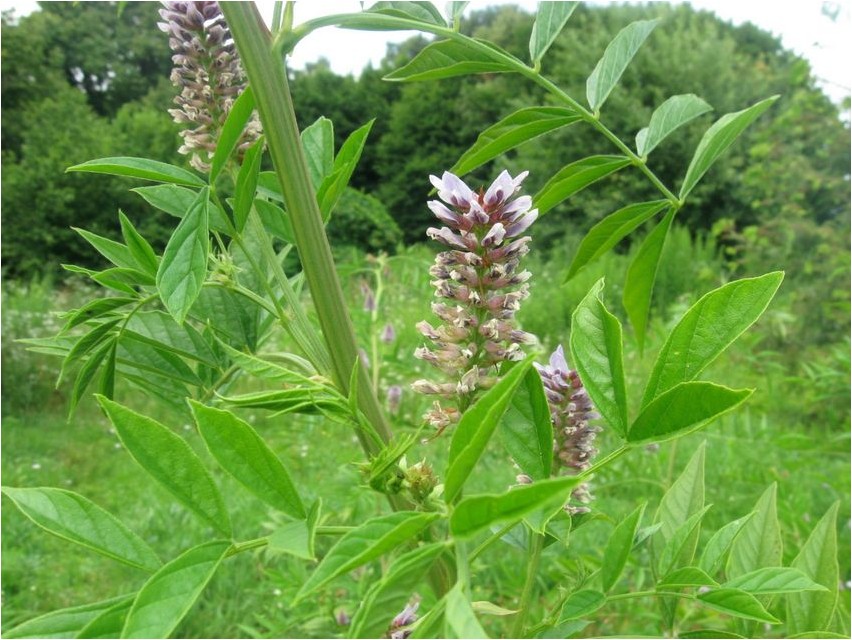
Korzhinsky’s licorice is one of the plants of the family called legumes; in Latin the name of this plant will be as follows: Glycyrrhiza Korshinskyi L.
As for the name of the Korzhinsky licorice family itself, in Latin it will be like this: Fabaceae Lindl. (Leguminosae Juss.).
Description of Korzhinsky’s licorice
Korzhinsky’s licorice is a perennial herbaceous plant, the height of which will fluctuate between thirty and seventy centimeters. The stems of this plant are glandular, glabrous and short-hairy, while the leaves can be oval or broadly elliptical in shape. The inflorescence of Korzhinsky’s licorice is a loose raceme, the moth-type flowers will be painted in pale purple tones. Unlike Ural licorice, in this species of this plant the calyx will not be endowed with a bag-like swelling.
The Korzhinsky licorice fruit is a leathery brown bean. the beans of this plant can be endowed with both short iron spines and sessile glands; they will be straight or somewhat sickle-shaped in shape. The fruits of this plant will sit on somewhat elongated peduncles than those of Ural licorice, and such fruits will not form dense cubes.
Under natural conditions, Korzhinsky’s licorice is found in the Aral-Caspian region of Central Asia, the Verkhnetobolsky region of Western Siberia, as well as the Zavolzhsky and Lower Volga regions of the European part of Russia. For growth, this plant prefers shallow ditches, meadows, saline steppes, banks and beds of oxbow lakes, drying up rivers, fresh and salt lakes, shallow ditches, low-water streams and rivers. It is noteworthy that sometimes Kozhinsky’s licorice can also grow in thickets.
Description of the medicinal properties of Korzhinsky’s licorice
Korzhinsky’s licorice is endowed with very valuable healing properties, and it is recommended to use the rhizomes and roots of this plant for medicinal purposes. The presence of such valuable healing properties should be explained by the content of vitamin C, essential oil, triterpenoids glycyrrizzic acid and methyl ester of acid, flavonoids isoglabroside and lycurazide in the roots and rhizomes. The aerial part of Korzhinsky’s licorice, in turn, will contain flavonoids and alkaloids.

It should be noted that the roots and rhizomes of this plant have become quite widespread for both medicinal and household purposes. In this case, this type of licorice will be used along with Ural licorice and naked licorice. It is noteworthy that it has been experimentally proven that total preparations based on flavonoids and individual flavonoids, among other things, will be endowed with the ability to provide pharmacological activity. For this reason, such useful elements that are present in Korzhinsky licorice can be used as antiulcer drugs.
As for the essential extracts of this plant, they are, in turn, endowed with the ability to provide very effective estrogenic activity. In addition, the following circumstance was also experimentally proven: when fed to various types of animals, Korzhinsky licorice leaves will, in turn, also exhibit estrogenic activity. It should be noted that this plant is endowed with quite a wide medicinal potential, but so far its medical capabilities have not yet been fully exploited. For this reason, new ways of using Korzhinsky’s licorice may appear in the near future.