Common butterwort
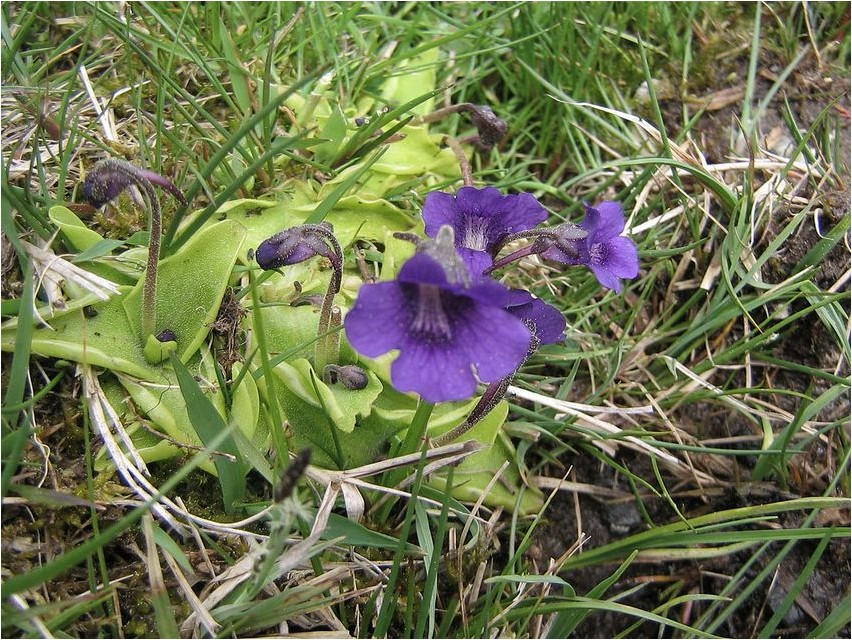
Common butterwort is one of the plants of the family called bladderwort; in Latin the name of this plant will be as follows: Pinguicula vulgaris L.
As for the name of the common butterwort family itself, in Latin it will be like this: Lentibulariaceae Rich.
Description of common butterwort
Common butterwort is a perennial herbaceous plant, the height of which is about five to fifteen centimeters. The stem of this plant is bare, and only in the upper part it will be slightly glandular and hairy. The leaves will be sticky and entire, they are oblong-elliptical in shape and taper into a vaguely defined petiole. Such leaves are found in a basal rosette. The flowers are painted in blue or blue-violet tones, they will be single and are on rather long peduncles. The spur is half as long as the rest of the corolla.
The common butterwort blooms from June to July. For growth, the plant prefers the territory of the European part of the Arctic, the Ob region of Western Siberia, the Caucasus, as well as the European part of Russia: the Volga-Kama, Karelo-Murmansk and Dvina-Pechora regions. The plant is also found in the Kuril Islands and Kamchatka in the Far East. For growth, the plant prefers places along the banks of streams, damp rocky slopes, hummocky meadows and swampy meadows.
This plant owes its name to the fleshy leaves of the common butterwort that shine in the sun. In fact, it begins to seem that the leaves of this plant are greased. This fat is actually a sugary liquid that will be secreted through numerous microscopic glands that exist to attract small insects. These fairly numerous glands cover the entire upper surface of the leaf; in fact, these glands look like tiny mushrooms on stalks. There are also peculiar mushrooms that are not endowed with legs. Such mushrooms will produce enzymes that help digest prey: various insects flock here and the leaf, as it were, captures them through a sugary liquid from which it is impossible to get out.
Description of the medicinal properties of butterwort
Common butterwort is endowed with very valuable healing properties, and it is recommended to use the herb of this plant for medicinal purposes. The term grass includes leaves, stems and flowers. The presence of such valuable healing properties is explained by the content of tannins, alkaloids, flavonoids and phenolcarboxylic cinnamic acid in the plant.

As for traditional medicine, both a decoction and an infusion of the herb of this plant is used as a wound-healing agent in the form of lotions for tumors, rashes, abscesses, burns and wounds, and also as a wash. The juice of the herb of this plant is recommended to be drunk for constipation, dysentery, respiratory and liver diseases, and in addition, this remedy is also used as a tonic and painkiller three times a day, one tablespoon.
It is noteworthy that in Western Europe, the herbal extract of this plant is used as an antitussive and expectorant. To prepare such a decoction based on butterwort, you will need to take three tablespoons of crushed dry herbs per two cups of boiling water. It is recommended to infuse the resulting mixture for two hours, after which this mixture is filtered very carefully. Take this remedy based on this plant, half a glass or one third of a glass three times a day before meals.





